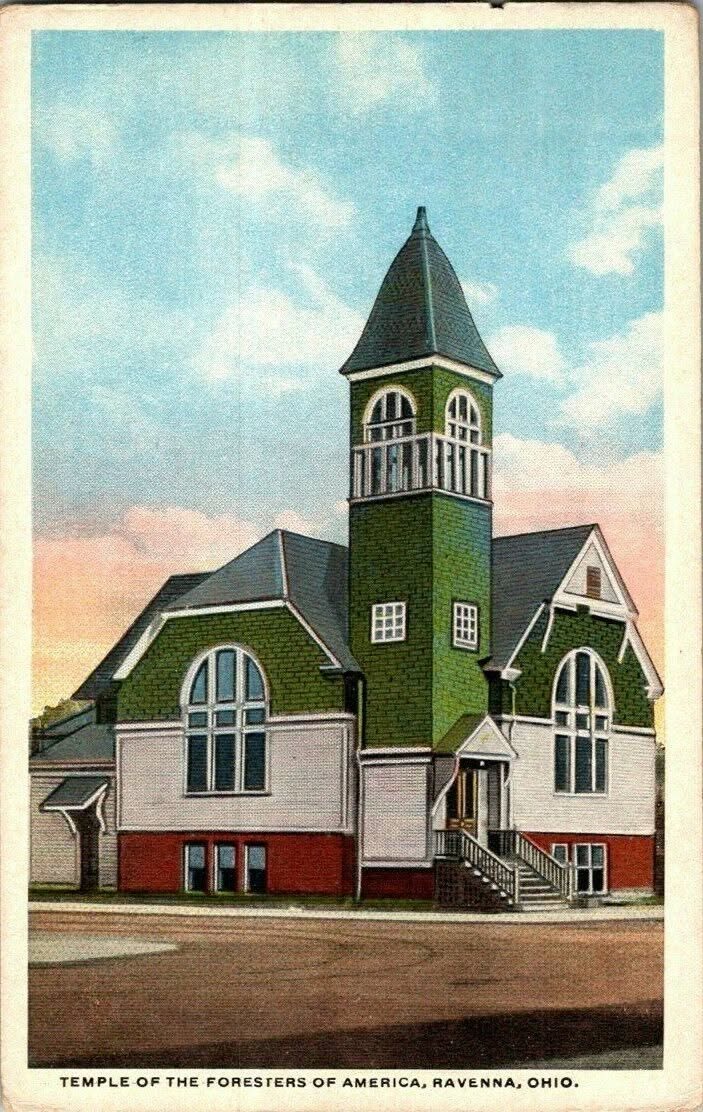
Ravenna Universalist Church
As Temple of the Foresters of America (Postcard)
Chestnut & Maple Lane
Universalist Church
Ravenna, Ohio
[Portage County]
Organized: 1837
Fellowshipped: 1841 by Western Reserve
A Christian Universalist sermon at a hanging, and a baptismal pact—before there even was a Universalist Church in Ravenna.
The Execution Sermon
We begin the sermon: In November 30, 1816 the noted Christian Universalist evangelist Rev. Timothy Bigelow preached a brief sermon in Ravenna during Portage County’s first hanging. The criminal was Henry Aunghst who murdered and robbed a peddler, Epaphras Mathews on august 20, 1814The hanging was public and well-attended we are told.1
History does not record the content of Bigelow’s sermon. It was rather uncommon for a Universalist minister to preach an execution sermon, as the theme of such sermons was fire and brimstone. The theme of Bigelow’s sermon, being a Universalist, undoubtedly was about the executed finding ultimate harmony with God.
The Baptismal Pact
The events leading up to the “Baptismal Pact of 1828” can be a bit confusing because of the two different, and simultaneous, meanings of the term “Restorationist,” and that both of the meanings overlap here. On one hand we have the “restorationism” of the Stone-Campbell Movement and on the other, the “restorationist” view held by some Christian Universalists. For the Stone-Campbell movement, “restoration” referred to restoring the original church. In Universalism, “restoration” referred to finding ultimate harmony with a divine after a short period of afterlife remediation.
The story behind the pact involves Ebenezer Williams, a champion of Christian Universalism in the Western Reserve and the Rev. Alyett Raines.2 Raines, as a minister followed Scott from place to place seeking to publicly destroy Rev. Scott’s (Stone-Campbell Movement) theological views which held to baptism for the remission of sins. Over the course of listening to Scott, Raines became converted to his thinking. Wanting to talk this over with another Universalist, Raines travelled in June to Ravenna to meet with Ebenezer Williams. After four days of discussion, mostly about the need for baptism, both became convinced of the message of Scott, converted to the movement and baptized each other in Sandy Lake. Interestingly, from historical records is appears that Raines and Williams retained their Universalist restoration view, even though becoming ministers in the Stone-Campbell Movement. After baptism, both men were held with some suspicion by both the Disciples and Universalists. Raines was referred to by the Disciples as a "Baptized Universalist." Although joining the Disciples, Williams also considered becoming a Mormon.3
The First Church (Spruce & Chestnut)
The seeds of Universalism were sown early in the Ravenna region. Many of the settlers arriving in the area from New England and other regions were Christian Universalists. Irregular meetings were held as early as the early 1820s by itinerant ministers. However, it wasn’t until 1837 that the Universalists in this part of Portage County organized a society. And it was not until five years later than a wood-frame meeting house was built on corner of Spruce and Chestnut Streets and dedicated on November 25, 1842. This church was unique in that it was held together by wooden pegs without any use of nails. The pastor at the time of dedication was the Rev. George Messenger, one of the first of the three school directors in Ravenna.
The original Spruce St. Church was outgrown by the mid-70s and was remodeled and enlarged and rededicated on July 29, 1877, perhaps as part of the Western Reserve Association Convention that was held that year in Ravenna.
On June 1, 1853 the Universalist Church in Ravenna made it into the New York Times:
25th and 26th of May, 1853 witnessed another exhibition of Woman's Rights in Ohio. The Convention assembled in the Universalist Church in Ravenna, on the morning of the 25th, the following notorieties being among the parties assembled: Rev. Miss ANTOINETTE BROWN,4 Mrs. SEVERENCE, Mrs. M. A. BRONSON, CAROLINE STANTON, Mrs. ALDRICH, Ex-Rev. JOE BARKER and L. A. HINE. A few "Bloomers," just enough for variety, were scattered through the audience.
In the mid- or late-1850s, the love-struck and spurned, Rev. Henry DeLafayette Webster came to Ravenna Universalist Church as minister. Webster is the author of the Civil War song, beloved by both soldiers of the North and the South, Lorena.
For several years, beginning sometime in the 1860s the church was served by Rev. Andrew Wilson, a popular minister, affectionately called the “Bishop of the Western Reserve” for his efforts to promote Universalism and establish churches. While at Ravenna he would often travel to Willoughby to assist the church during pastoral vacancies. Rev. Wilson served the congregation until retiring in 1898. After retiring from the pulpit of the Ravenna Church, Rev. Wilson continued to pastor the Brimfield Universalist Church (which he had helped to organize in 1865) "as long as he was able to ride to its doors." Rev. Wilson died in 1911.
The Second Church (W. Chestnut & Maple Lane)
Outgrowing the remodeled church, a new church was built and dedicated on February 28, 1891. The new church was located on southeast corner of W. Chestnut and Maple Lane, just up the street from the old church. Its location made it famous as the first stop of the streetcar line as it entered into Ravenna.
Following the dedication of the new church, the 1842 church was sold to Warner Riddle. Along with a few other modifications, Riddle lowered the ground floor and in 1893 rented the building to the Village of Ravenna for use as a fire station, for a monthly rent of $200. After the new City Hall was built in 1922, the building became a freight station for both the streetcar and railroad. In 1951, the Spruce Street church was demolished and the land was sold to D. T “Whitey” Kilgo to serve a motor terminal for his trucking company.5
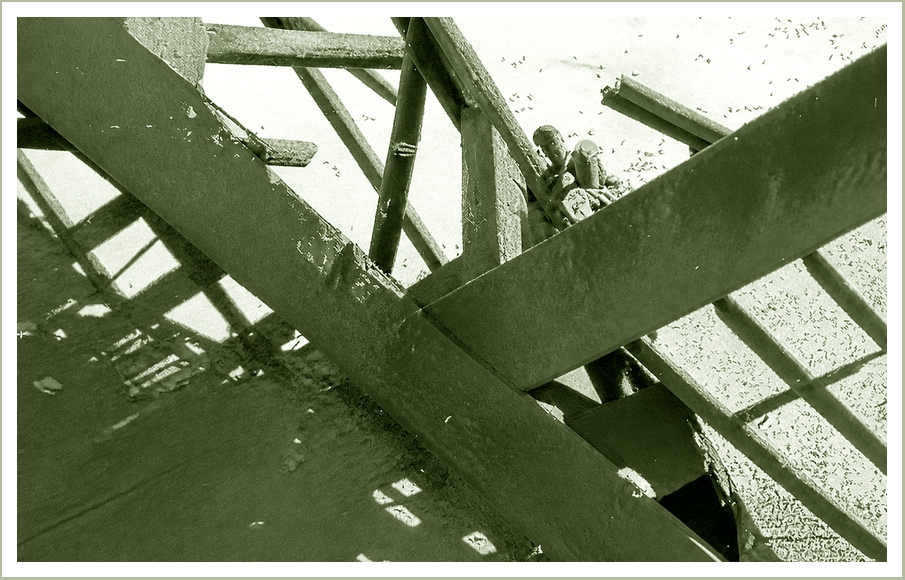
Sprice Street Church being Demolished, 1951
Nov. 6, 1951 Ravenna Courier
The new brick church built at a cost of about $8000, completed late 1890, was Late-Victorian in architectural design, featuring arched windows and a prominent tower. The Democratic Press wrote of the building: “Everything is modern, tasty and convenient and a more home like, attractive church cannot be found in Portage County.” The article went on to note that the auditorium was outfitted with opera chairs, and could seat 200 hundred people comfortably. The east portion of the building, entered through a “gracefully double-arched doorway,” consisted of a main room and three class rooms, “very pleasing to the eye.” The pulpit, according to the article, was arranged so that a good view good be had of the preacher from any part of the sanctuary.
The dedication speaker was Rev. C. E. Nash of the Kent Church. His sermon was taken from James 1:27: “Pure religion and undefiled before God and the Father is this: To visit the fatherless and the widows in their affliction and to keep himself unspotted from the world.” It was said that the sermon included an excellent defense of the Universalist doctrine.6
News reports at the time noted that over 500 people attended the morning dedication service. Many more, it was noted arrived too late to gain admittance. Those attending included a large contingency from the Akron Church and most of the members of the Kent Church, which had cancelled their service. Those who remained over for the evening service were treated to a delicious meal in the church’s elegant dining hall. It was noted by Rev. Wilson when making the announcement that everyone would have the opportunity for “good square meal.”
The evening preacher, preaching before almost as large a crowd was Rev. D.V. Cone, President of Buchtel College. In between services, there was entertainment and a Young People’s Christian Union was organized with about 30 members.
With the retiring of Rev. Wilson in 1898 the church began to decline. To some extent, due to the fact that much of it was centered around the personality of Rev. Wilson. And to a smaller degree, a succession of ministers following his retirement. By 1902, church services were disbanded, although the society was not formally dissolved until 1912.
Following Rev, Wilson was A.F. Spanton who served until fall of 1900. He was followed by Rev. Martha M. Spelman who after a few months, reigned due to a crisis of faith.
The church was sold in December of 1911. The time between the last service and the selling of the church was due to a hope that the congregation could be revived. Even when the church was sold by the Ohio Universalist Convention to W. G. Smith for use as Foresters Temple the principal of $4150 was to be held for “a reasonable time, for a new church in the event of one being reinstituted. The interest was to go to missions.8
Finding New Use
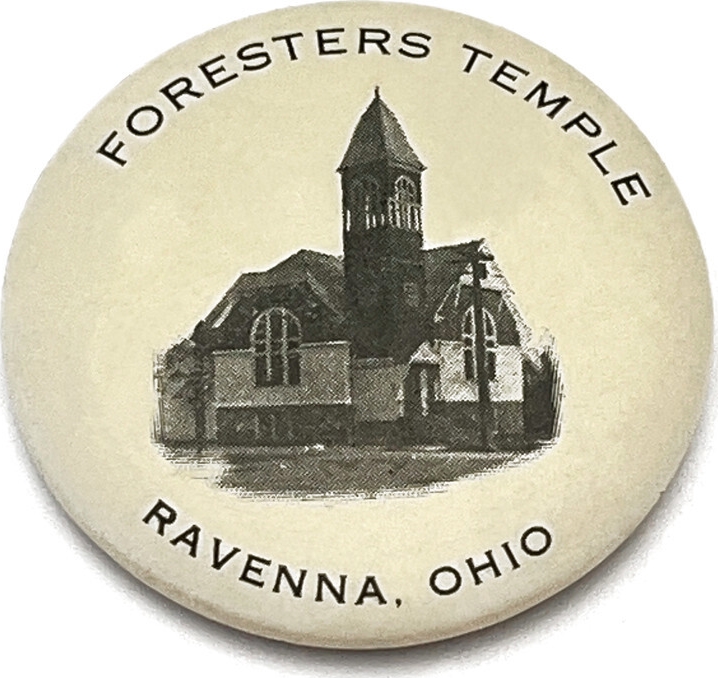
Forester Temple Pin, 1926
While a Foresters Temple, the building was used as in 1917 by the local Christian Science Society before moving to another building. Between 1926 and ’27, First Congregational Church temporarily used the building while their church was being built. As two local congregations utilized the Temple, ten years apart, we can assume that other than some repairs the Foresters left the building pretty much as it was a church.
The Foresters use the building until 1953 when became a Moose Lodge. Many older residents of Ravenna remember attending youth dances at the lodge, as well as taking lessons there from a Miss Beitz in the late 50s. Several mentioned that even though they danced in Lodge they had no idea that it was once a church.
In 1969 the building again changed hands. The new owners were the Law Firm of Loomis, Jones, Wilson, Poland and Griffith for use as an office. Shortly thereafter, the County Purchased the building and demolished it to provide space for the Portage County Prosecutor’s Office.
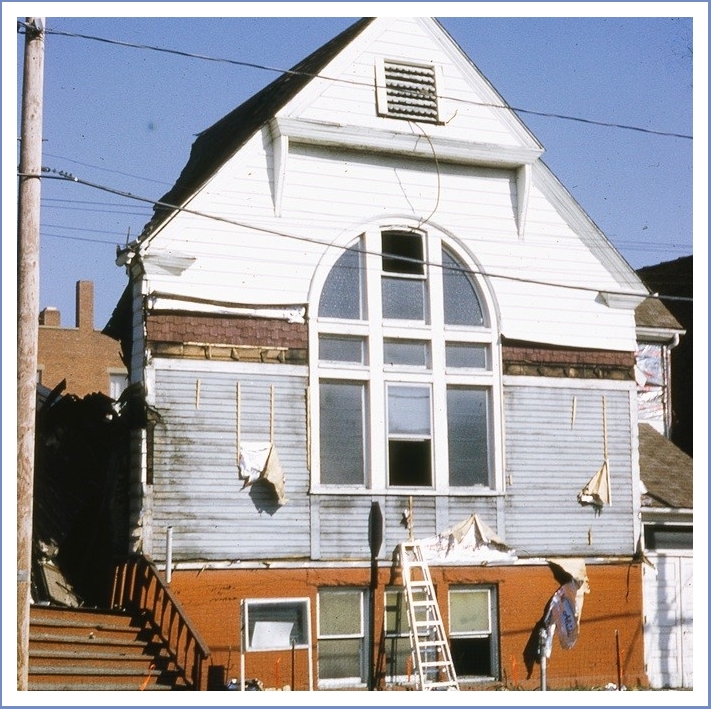
Demolishing Chestnut St. Church Building - 1969
Notes:
A big thanks to Kevin Gray, Reference Librarian at the Reed Memorial Library, Ravenna, Ohio, for providing information and photos, as well as clearing up the questions I had.
1. “The Most Noted Criminal Events in the History of Portage County,” 1885 History of Portage County, Ohio.
2. Hayden, A. S., “Aylett Raines,” History of the Restoration Movement. (History of Disciples on the Western Reserve, pages 150-154.)
3. “One Hundredth Anniversary of the Christian Church, Ravenna, Ohio, May 11, 1930." See also Robinson, The Universalists in Ohio, p. 52-53.
4.
6. Democratic Press, Ravenna, OH, March 4, 1891.
7. Evening Record, January 10, 1901. Rev. Spelman was concerned that she was neglecting some spiritual duty to herself and others, those performed by those who called themselves “Evangelical Christians.” Apparently, this was something that had troubled her even as a child reared in the Christian Universalist Faith. In a fit of anxiety, she resigned from the church. The editor of the Evening Record presented Rev. Spelman the opportunity to address her resignation and to write that she was still a Christian Universalist.
8. Di Paolo, Roger. “Foresters dedicated 'temple' in Ravenna in 1912” Portage Pathways, Roger Di Paolo.” Record-Courier, Aug. 16, 2015.
Bibliography & Resources:
Democratic Press, Ravenna, OH.
Evening Record, Ravenna, OH.
Gray, Kevin, Information Librarian, Portage County Public Library.
Harp, Scott, Editor. History of the Restorationist Movement.
Holm, James, B.(ed), Dudley, Luculle (assist ed.) Portage Heritage, Portage County Historical Society, (1957).
Humbert, M. Dale. One Hundredth Anniversary of the Christian Church, Ravenna, May 11, 1930. [Digital Commons@OCU (Okhomama Christian University)].
Mills, Frank, “Love Lost & A Heart Broken Minister,” Christian Universalism (2025).
New York Times, June 1, 1853.
Record-Courier, Ravenna, OH.
Robinson, Elmo Arnold. The Universalist Church in Ohio (1923), Ohio Universalist Convention.
Stranahan, H. B. [pub], Atlas of Portage County, 1900.
Troyer, Loris C., "Portage Pathways," 1998.
Warner, Beer (ed), History of Portage County, Ohio, 1885.
Watters, Florence Gray, “Organization of Religious Life,” typed memoir. Source: Reed Memorial Library.
You Should Know Ravenna, Business Men’s Association, early 20th c. Source: Reed Memorial Library.
Images:
Unless otherwise noted, courtesy of Kevin Gray, Reference Liberian, Reed Memorial Library.
Background: AI colored
Picture of Spruce St. Demolition, AI enhanced.
Church history will be updated as new (or corrected) information and pictures become available.
Posted: October 23, 2026
Frank A. Mills