Christian Universalism

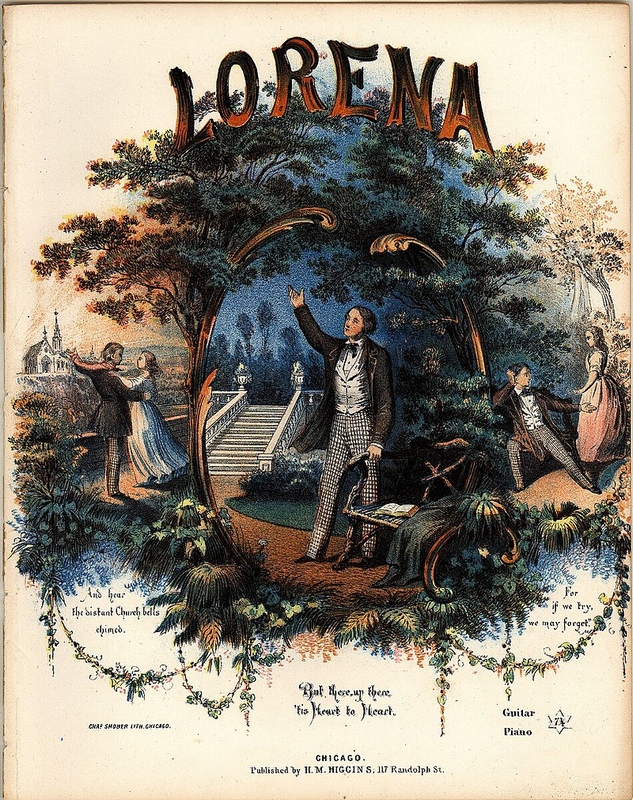
Lorena: The Song That Ended the Civil War
Sheet Music Cover, 1870's
Lost Love & A Heartbroken Universalist Minister
And a Song that Perhaps ended the Civil War
The story of that past, Lorena,
Alas! I care not to repeat,
The hopes that could not last, Lorena.
For "if we try we may forget,"
Were words of thine long years ago.
Way back when, sometime as the 1840s ended and the 50s began there was a lovestruck Christian Universalist minister tending the flock in Zanesville, OH, the Rev. Henry DeLafayette Webster. It seems that the lovely Martha Ella Blocksom (“Ella”) caught the eye of the Reverend as she sat before in the pews. And it appears that it was reciprocated, for she became his fiancée.
Ah, but there was a catch—
Miss Blocksom lived with her sister and brother-in-law, Henry Blandy. [In those days it was not considered proper for a young unmarried woman to live by herself.] Blandy and his brother Fred owned the Blandy Foundry. And naturally, it was unnatural for a wealthy and prominent member of the community to have his sister-in-law romantically attached to a lowly, poor minister. After all, he was not the minister of one of the Zaneville’s prominent, socially acceptable church (although apparently the family attended the church). So, the brothers put an end the relationship, but left it up to Ella to tell Henry that it must end. However, unable to face the poor parson, she ended the romance in a letter. In the letter was the phrase, “If we try, we may forget.”
The heartbroken pastor resigned and moved on. In 1854, Ella married William Wartenbee Johnson who in time became a justice of the Ohio Supreme Court. Henry eventually married and ministered in Ravenna, OH and Chicago, where he died.
But although the romance came to a sad end, the story did not end with that letter.
In 1856 Henry Webster met another Webster, Joseph Webster (who later composed the music for “[In the] Sweet By-and-By”). J.P was in search of lyrics for some music he was composing. Henry responded with a ballad about his lost love, changing the name from “Ella” to “Bertha.” Needing three syllables, “Bertha” became “Lorena.” In 1857, the ballad was published by Higgins Brothers (Chicago) and quickly became a popular American ballad. Of course, both Websters were happy with the outcome. What Miss Blocksom thought, we do not know.
Yet, the story is not ended.
During the Civil War the ballad as a love song took on special meaning, especially so in the South. Soldiers on both sides were leaving their sweethearts behind. When they heard the sad song, the homesickness set in. At least one Confederate officer attributed the South’s defeat to the “Lorena.” Hearing the mournful lyrics, the rank-and-file becoming homesick, lost their will to fight. Retreating from their defeat at the Battle of Atlanta, General John Hood and his troops somberly sang Lorena as they parted the city.
Today as we listen to lyrics of “Lorena” we cannot help but reminded of how divided we have become as a people and a nation Another civil war—a very uncivil one.
A Few Notes:
“Lorena,” as an instrumental version has appeared in several movies and television shows, and even in a 2018 video game. The song with words was recorded by Tennessee Ernie Ford (1961, Tennessee Ernie Ford Sings Civil War Songs of the South, Johnny Cash (Johnny Cash – 1970) and the Mormon Tabernacle Choir (1961, 62).
Zanesville – In 1834, the Rev. George Rogers, an itinerant minister, met considerable opposition while seeking to established a Christian Universalist fellowship in Zanesville. His preaching drew only the males of the city. Over the next few years, the fledging congregation was pastored by itinerant ministers. Rev. Henry Webster arrived in and was installed as minister in 1848. He appears to have resigned in 1854, perhaps when Ella married. After leaving Zanesville he ministered in Ravenna, OH. During the Civil War he was an army physician and pastor of the Tarpon Springs, FL Universalist Church. Following the war he returned to Ravenna. Eventually his ministry led him Chicago, where he died. The church lasted at least until the late 1800s.
The Lyrics:
Oh, the years creep slowly by, Lorena,
The snow is on the ground again.
The sun's low down the sky, Lorena,
The frost gleams where the flow'rs have been.
But the heart beats on as warmly now,
As when the summer days were nigh.
Oh, the sun can never dip so low
A-down affection's cloudless sky.
A hundred months have passed, Lorena,
Since last I held that hand in mine,
And felt the pulse beat fast, Lorena,
Though mine beat faster far than thine.
A hundred months, 'twas flowery May,
When up the hilly slope we climbed,
To watch the dying of the day,
And hear the distant church bells chime.
We loved each other then, Lorena,
Far more than we ever dared to tell;
And what we might have been, Lorena,
Had but our loving prospered well --
But then, 'tis past, the years are gone,
I'll not call up their shadowy forms;
I'll say to them, "Lost years, sleep on!
Sleep on! nor heed life's pelting storms."
The story of that past, Lorena,
Alas! I care not to repeat,
The hopes that could not last, Lorena,
They lived, but only lived to cheat.
I would not cause e'en one regret
To rankle in your bosom now;
For "if we try we may forget,"
Were words of thine long years ago.
Yes, these were words of thine, Lorena,
They burn within my memory yet;
They touched some tender chords, Lorena,
Which thrill and tremble with regret.
'Twas not thy woman's heart that spoke;
Thy heart was always true to me:
A duty, stern and pressing, broke
The tie which linked my soul with thee.
It matters little now, Lorena,
The past is in the eternal past;
Our heads will soon lie low, Lorena,
Life's tide is ebbing out so fast.
There is a Future! O, thank God!
Of life this is so small a part!
'Tis dust to dust beneath the sod;
But there, up there, 'tis heart to heart.
[Story may be updated as new information comes to light.]