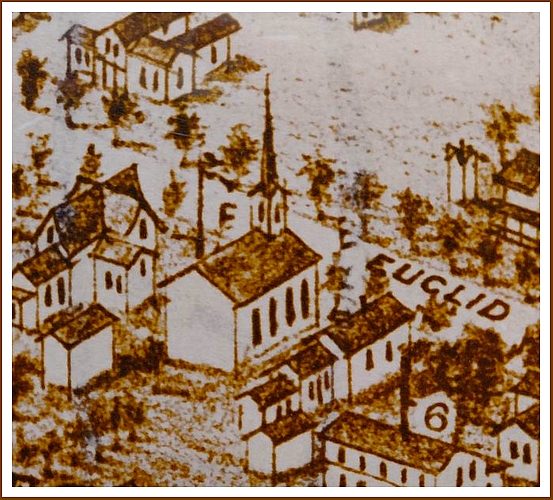
First Universalist Church, Willoughby
"The Church that Moved"
(Lake County)
1855 – 1882 [1891 (?)]
38012 Euclid, Euclid Ave (Current Street Numbering)
Church: Wood-framed vernacular, with steeple. “Built” around 1855.
Sold around 1890. Remains today as a residence (37789 Park Ave)
Background mage: An drawing of Willoughby dated, 1883. The original is in the Willoughby Welcome Center.
The Church that Moved – Literally
[Although there are a number of nebulous, and often conflicting dates, along with conflicting reminiscences on the Willoughby Universalist Church history I have sought to weave a history that matches as close as possible, the official Universalist Convention and Association records. Undoubtedly though, this “history” will need to be amended as new information comes to light.]
First by a tornado. Then by a mules and rollers, and then twice again. Four times the church was moved. It began in Kirtland as the South Congregational Church and then became the First Universalist Church of Willoughby (in Willoughby of course) and ultimately ended up after the final fourth move as a Willoughby residence.
Although the doctrine of Christian Universalism arrived early in the Western Reserve it is hard to pinpoint when the doctrine of Christian Universalism arrived in Willoughby. At the turn of the century settlers who held to the doctrine began to arrive. The first Universalist minister, Rev. Timothy Bigelow arrived in Portage County by 1814, perhaps earlier, and established a preaching circuit throughout the area (one that eventually covered most of Ohio). Bigelow was followed by others preaching the “Gospel of universal salvation.” Although not well-received at first, through the efforts of these circuit-riders, Christian Universalist Churches began to spring up in the Western Reserve.
The Encyclopedia of Cleveland History places the arrival of Christian Universalism in Willoughby no later than 1850. Robinson (Christian Universalism in Ohio, 1923) notes that Willoughby’s Universalist Church was organized and fellowshipped in 1855, and around that time built a church.
“Built” is a bit of a misnomer. “Reconstructed” would be better. What became the First Universalist Church of Willoughby began as a Congregational Church in Kirtland, seven miles to the south. That edifice was built in 1828.
In 1842 a tornado whipped through Cuyahoga and Lake Counties, turning the Kirtland South Congregation church sideways on her foundation. A vernacular history of Kirtland, "Reminiscing in Kirtland," notes that the Congregationalist repaired and used the old church until their new church was completed in 1859. Sue Clark, the historian for South Congregational Church, writes that the Universalist purchased the old wood-framed church and moved it from Kirtland to Willoughby. Although just seven or so miles, not an easy move—hilly terrain and the Chagrin River to crossed.
Robinson has the 1856 Western Reserve Association Convention being held in Willoughby. Whether in a Universalist Church or elsewhere is not mentioned. Given that the new South Congregational Church was not occupied until ’59, and with the cornerstone being laid a year of so earlier, I think the moving of the church would have been closer to 1858. The Lake County 1857 Survey Map has the property vacant of a building.1
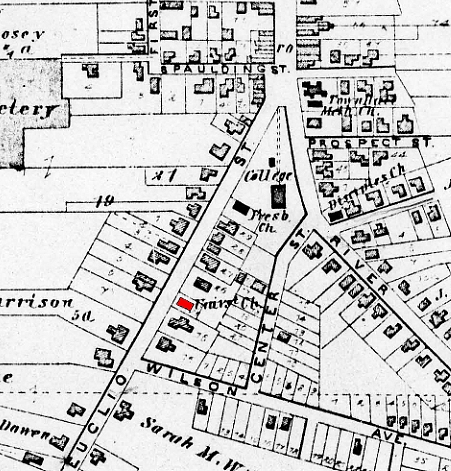
1874 Lake County Atlas Map
Lot 25 - Church is red
About where Dollar Store is now.
The final days of the church as an active church are as enigmatic those of the beginning days. Robinson writes that the church was sold around 1890, but the congregation remained active for a while after.2
Available church records in the Harvard Divinity School Library cover the years from 1855 to 1882, yet the Universalist General Convention shows the church making financial contributions until 1891. Local newspaper accounts appear to confirm that the congregation remained active, perhaps even after 1891. The church hosted the Western Reserve Association’s Conventions in 1875 and ’80. During the church's period of activity the building hosted numerous civic events.
Yet, it also appears that the congregation was struggling. There were gaps in ministerial leadership contributing to loss of membership and financial difficulties. The Disciples of Christ co-used the church between 1873 and 1875. The Rev. George Perin is mentioned as the pastor in 1879 and again in 1881, perhaps as pulpit supply, as he was the minister of the Bainbridge Church at this time. It does seem that an attempt was made at stability, The Rev. Henry Noble Couden, D. D. filled the pulpit between 1881 and 1883.
Following the ministry of Couden the church was apparently vacated and subsequently rented by the Grace Episcopalian Church while their new church was being built across the street.
The Willoughby Independent through the 80s and into the early-90s notes that the Willoughby Universalists held monthly socials in members’ homes, attended meetings in Mentor, Bainbridge and Newton’s Grove, a popular picnic area on Lake Erie.4
Interestingly, a notice in the April 15, 1887 Willoughby Independent, notes that the church had been purchased by Willoughby businessman, Mr. F. C. Carrell, and was being demolished to be rebuilt as a residence under the direction of J. L. Armstrong. Although the church was not actually torn down, the date does fit with Robinson's note that the church was sold “around 1890.” However, Carrell does not appear as the plot owner until the 1915 Lake County Survey Map. The 1898 Survey Map makes no notation of owner.
We pick up the story in 1910 when, according to South Congregational Church history the new Andrews Institute for Girls (now Andrews Osborne Academy) opened. During the Academy’s first years there was a need for faculty housing, which was solved by turning the church into a faculty dorm. Although not remaining as a dorm for very long, the church continued served as a meeting space and auditorium. After 1920, the Academy vacated the building and the building was purchased by Lawrence McMahon who moved it to the rear of his parking lot (where Manning Law Office is now). McMahon used the top floor to display caskets and the main floor for funeral services. When McMahon joined his father’s firm a few years later, he abandoned the building. Although there are conflicting dates as to when, the church was sold and moved for the fourth time to 37789 Park Ave, to become a residence. It is this role that it still holds today.
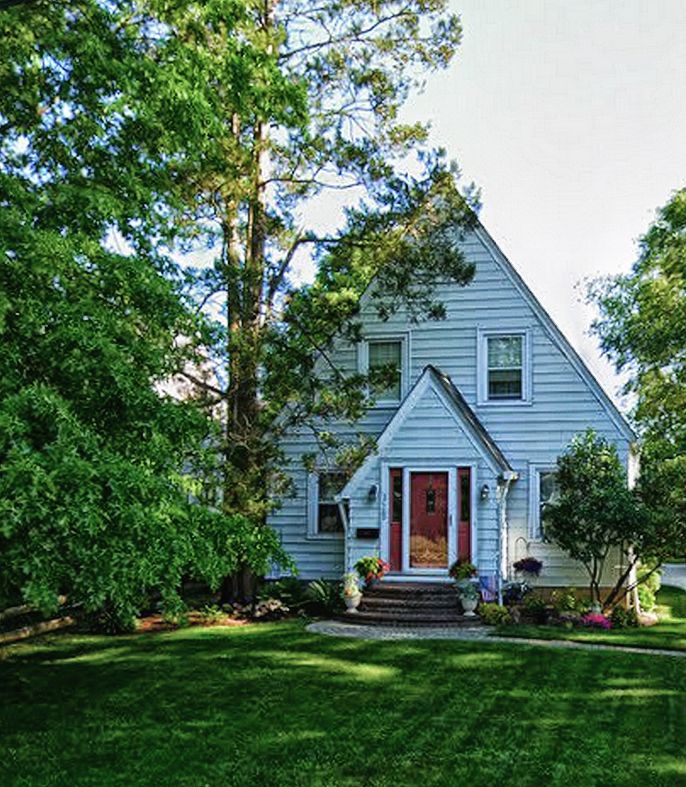
Today as a Residence
Although there is no obvious direct continuation, the spirit of Universalism lives on through the ministry of the East Shore Universalist Church in nearby Kirtland. That church was founded in 1956 in Mentor, OH, just to the east of Willoughby.

The church, when active, was served by several notable Universalist ministers:
Andrew Wilson, D.D.
In 1860, Wilson entered into ministry at Willoughby. Wilson was affectionately referred to as the “Bishop of the Western Reserve.” Unofficial, of course, as Bishops did not exist in the Christian Universalist Church. At his death it was said that he had performed 1211 marriages and 2128 funeral ceremonies. A denominational record. One that I suspect still holds. Wilson worked tirelessly promoting Universalism and Buchtel College (now the University of Akron, then a Universalist college).
Eldridge Whitney
Whitney who came to Willoughby in 1866, and was greatly respected for his sermons and oratorical skills.
Rev. George Lander Perin
In 1879 and 1881 Rev. George Lander Perin is listed in local newspapers as the minister of the church. At the same time, he was pastoring the Bainbridge Church. In seminary Perin was the roommate of Couden (see below), and remained fast friends throughout their lives. Rev. Perin is considered the founder of the denomination’s Japanese mission (1890). He was also an author of several religious works.
Henry Noble Couden, D. D.
Couden, pastored the Willoughby congregation from 1881 to 1883. Due to a Civil War injury, Couden was blind, while blind he finished seminary and was ordained to the ministry. In 1878. In 1895, the Republican controlled House of Representatives appointed Couden, a Republican, as House Chaplain. He served in that position, even when the house was controlled by Democrats, until he retired in 1920. While in Willoughby, Couden often joined George Lander Perin on preaching and lecture tours throughout the region. The circuit was focused on “applied Christianity,” bringing public lectures, social events, and holiday services to tight-knit farming. The rotation was generally preaching every other Sunday at Willoughby, with the other Sunday, and some weekdays, given over to the circuit.
Notes
1. The Welcome center map showing the church is dated 1883. The church shows up in latter survey maps, but by 1898 the building no longer appears on the maps as a church.
2. Robinson, p.163.
3. Grace Episcopal Church, now part of the McMahon-Coyne-Vitantonio Funeral Home.
4. “Newton’s Grove was located along the Lake Erie shoreline in Lake County, Ohio, exactly 3 miles north of the Willoughby railroad station, where Willoughby meets Mentor. It was considered a major lakefront park and grove where massive regional events were staged. It regularly hosted high-profile community events such as Fourth of July celebrations and the large annual military reunions for the 88th Regiment of the Ohio Volunteer Infantry.” – Karen Kragge
Correspondence & Conversations
Sue Clark, Church Historian, South Congregational Church, Kirtland, OH.
Rick DeVan, Supplied 1883 map
Karen Kragge, Information on Newton’s Grove
Robert Manross, Links to Lake County Survey Maps
Kaity Oriti Weber, General information
Willoughby Area Welcome Center
Bibliography:
“Unitarian-Universalism,” Encyclopedia of Cleveland History, Case Western Reserve University, .
Dictionary of Unitarian & Universalist Biography.
Lake County Survey Maps, 1857, 1874, 1898, 1915, Lake County Government.
Robinson, Elmo Arnold. The Universalist Church of Ohio (1923). Ohio Universalist Convention.
Wilcox, Pearl, “Reminiscing in Kirtland. Part 2,” Saint Herald, Vol 105, 1958
Willoughby Independent (1881 – 1885)
[Posted: 07.23.26]
[Church history may be updated as new information comes to light.]