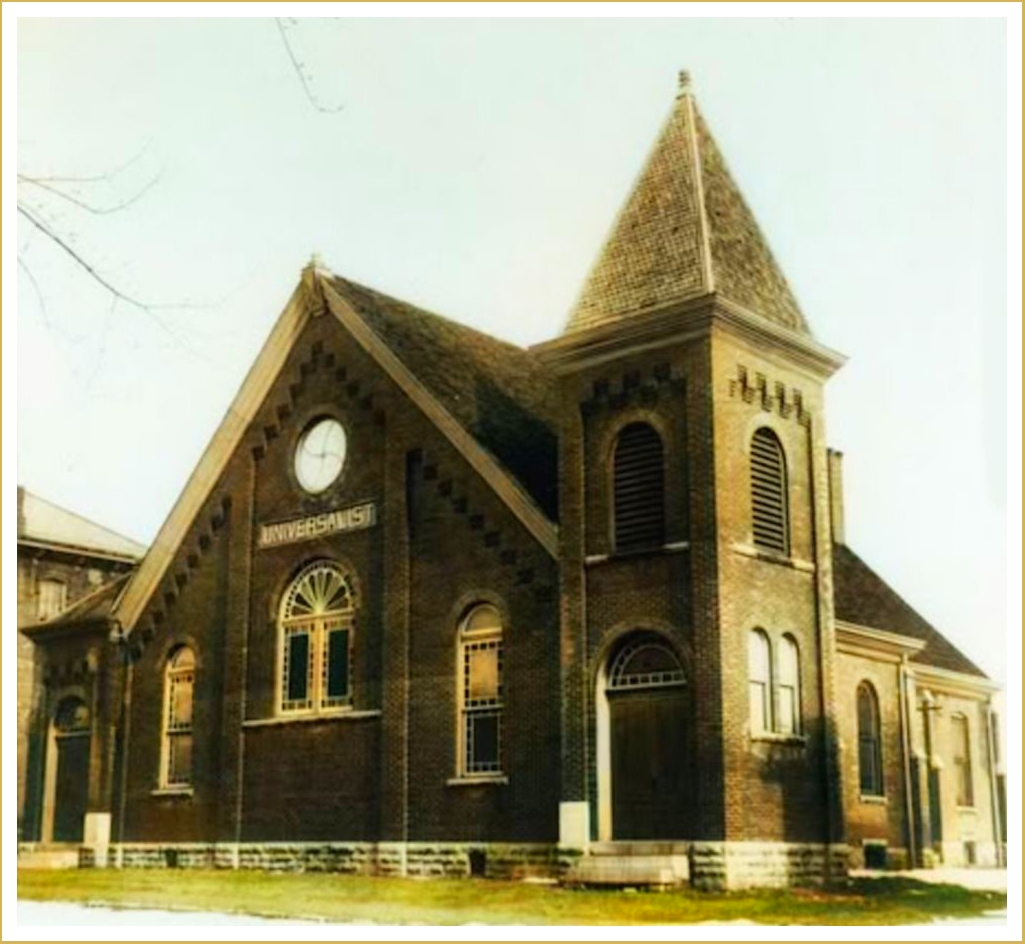
Universalist Church (n/d)
Universalist Church
Plain City, Ohio
(Madison County)
1832 – ca 1950
Semi-Gothic Red Brick with Bell-Tower
Architects: C. A. Stribling & Company (Columbus)
Built: 1889-1890 Dedicated: June 8, 1890
Cornerstone: Set by Urian Lodge, #311 F.A.M.
Current Use: Christian Life Church / 2005 (Restoration in progress)
If you rely on one source for information, the information given can be confusing. This is especially so when there are no early official church records other than brief notes. For those researching the early Christian Universalists of Ohio the primary source is Elmo Arnold Robinson and his, The Universalist Church in Ohio (1922). Robinson with a few words, conflates Plain City with Pleasant Valley and then elsewhere mentions “Darby (Creek) and Union” and “Irwin,” gives a date, and then says, “See Plain City.” And with Plain City, “See Darby.” Period. Nothing else. So, if you are left with Robinson, you are left to wondering how these Universalist Societies are connected. What is perplexing about his brevity is that in 1917 was called to minister at Plain City. Interestingly, he does mention himself with a brief “Robinson” as one of the church’s ministers.1
Fortunately, for those of us researching the history of the Plain City Universalists there is another source, a rather detailed one, in the 1915 History of Madison County compiled by Chester E. Bryan, that goes a long way in helping us sort things out.
The Family Tree
The area around Plain City, before there was a Plain City (and even after there was) was referred to as “Pleasant Valley,” and a Universalist Society was organized as “Pleasant Valley” in 1832. The Society made arrangements with the Rev. Charles Rogers of Worthington (OH) to preach once a month at Pleasant Valley. His compensation, as it was for many of the itinerant preachers of the day, was whatever was in the day’s penny collection (offering). Travel in those days could be a harrowing experience, and the good reverend came close to losing life more than once.
Universalism – God is Love and that all will ultimately find harmony with God – while still novel in the 1830s had been preached for some years as itinerant Universalist preachers passed through the region know as Pleasant Valley.
In 1835, the growing Society reorganized and called Rev. William H. Jolly of Jersey (Licking County) to be their first officially employed pastor, contracting with him for one Sunday a month.
Rev Jolly preached in an old school house that stood about two and a half miles west of town in Union Township (Union County). This I suspect is where Robinson’s “Union” came from. Services were held at the school house until Dr. D. K. Bigelow erected a large barn on his farm and offered it for church services. It was said that the barn was filled to capacity for every service, “people were sitting on the crossbeams and large timbers overhead.”2 As the Bigelow farm was in Darby Township and encompassed the Little Darby Creek, Robinson’s ”Darby (Creek)” refers, I think, to when t he Society meet in Bigelow’s barn.
Following Rev. Jolly, the Society called Rev. W. Y. Emmett as pastor. With the congregation growing, Rev. Emmett began a reorganization of the Society. It was finalized in 1842, officially as “Pleasant Valley,” with 25 members. Although the first Society was “fellowshipped” by the Central Association, the reorganized Society became part of newly formed Winchester Association. After Rev. Emmett left, Rev. William B. Linnell assumed the role. .
The First Church
Following Rev. Linnell was Rev. Cyrus Filmore Wait (1846-47). It was under Rev. Wait that the congregation began to construct their first church on South Chillicothe St, completing it in the summer of 1848 or ’49. II was dedicated in June of 1850. There is no record of why the dedi8cation was delayed. Bricks for the church came from the brickyard opened by members John McCloud and Maturin Harris.
What distinguishes this church is that it was the first regular church to be built in Plain City.
“Nobody worth saving”
Rev. Wait remained pastor of the church and was well-liked until he put his foot into his mouth. In 1864, he famously stated, “(S)ince the death of Dr. D. K. Bigelow and E. C. Smith Sr., there was (sic) nobody about Pleasant Valley worth saving.”3 Naturally, the town and the congregation took exception (although there were some who sided with Rev. Wait), and Rev. Wait was dismissed. Plain City was his last parish. Rev. Wait died the following year.
For a short time, while the church was without a called pastor, the Rev. J. W Henley filled in as pulpit supply. It was during this period that a Sunday School was established.
All the while the good folk of the congregation were thinking that there were still people in Pleasant Valley worth saving, no matter what the Reverend thought, and thus in 1865 called the Rev. W.W. Norton as pastor.
During the five years that Rev. Norton served the congregation, it is said that he mended broken fences with the town folk, undoubtedly caused by Re. Wait’s unwise words, brought harmony to the congregation, and admirably administered a growing congregation.
A Segue: Irwin
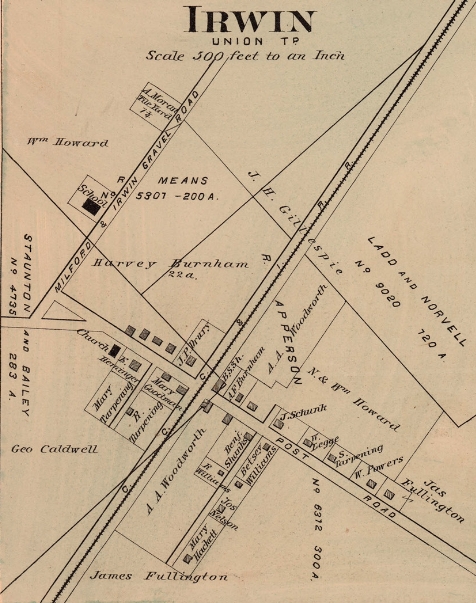
The town of Irwin is about 12 miles from Plain City. A Universalist Society was organized there in 1863, long after the reorganization of Pleasant Valley in 1847. We can only speculate on the connection. It is possible that an Irwin Society was organized as a mission project of the Plain City Universalist congregation. It is also possible that when the Irwin church dissolved her members joined Plain City. Whatever the case, the church did not last long. What is tantalizing, at least to this researcher, is that on the Irwin Plat Map of 1877, a church with no name is shown. This could very well indicate a vacated church building.
The New Church
With a growing increase in attendance the church debated the need of a new building for several decades, but it wasn’t until a series of “revival-style” meetings in March of 1889 brought into the church a large influx of new members that it was decided to go ahead with the construction of a new edifice.
After considering a number of submitted plans, the building committee chose the plans submitted by C. A. Stribling & Company of Columbus. Work commenced in September of 1889, weather cooperated and construction went well. The vestry was completed around Christmas, with the congregation occupying the space until the sanctuary was completed. The cornerstone was set by the Urian Lodge, #311 F.A.M. The church was dedicated on June 8, 1890, with Rev. A.K. Beem as pastor. The total cost, $7,000.
Byran’s "History of Madsion County describes the church in some detail:
The pulpit is at the west end, with a large stained glass above it. The window bears the inscription, “God is Love.” The floor rises gently from the pulpit toward the vestry. The walls are wainscoted to the height of 5’ The ceiling is open. Pews are arranged in semi-circle The choir is to the left of the pulpit, set off by a rail. The church had a organ, a gift from a member. The cost of building the church was $7000.4
This church that still stands on S. Chillicothe St., but it almost met its end with the tornado of 1912. It was repaired and rededicated in 1913 and remodeled in 1929. The Society disbanded sometime in the mid-1900s.
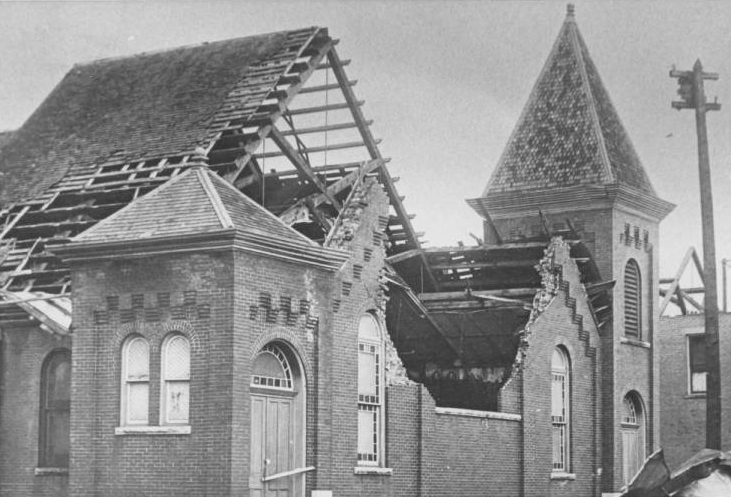
1917 Tornado Damage
During the construction of the new Plain City High School (now at 340 West Main Street) in 1936, the congregation kindly opened their doors to allow students to hold classes in the church. This task was also shared by the Methodist, and Presbyterian churches.
The Ohio Convention of Universalists held their 1910 and 1920 convention at Plain City. The Central Association in 1919.
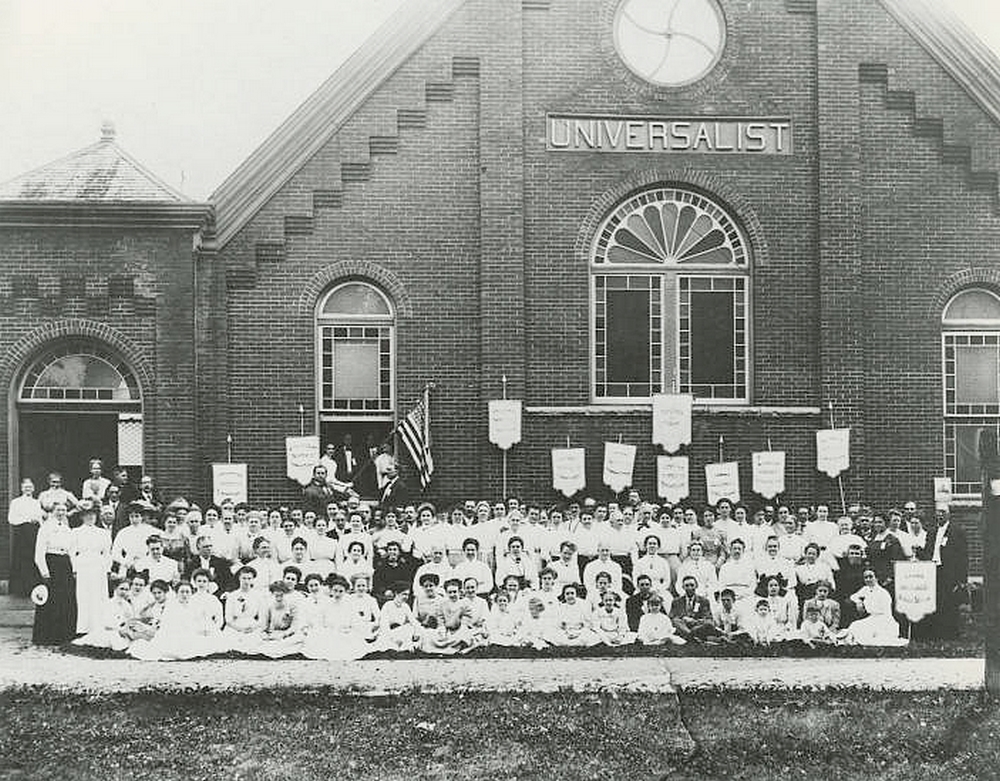
ANo date nor identification. Perhaps a Sunday School, Temperance or State Convention.
After The End
In 1962 the church building was utilized for city office and the fire department. Other uses have included the Farm Bureau, Gospel Light Mennonite Church and in 1982 the Church of God. Since 2001 the building is home to the non-denominational Christian Life Church.
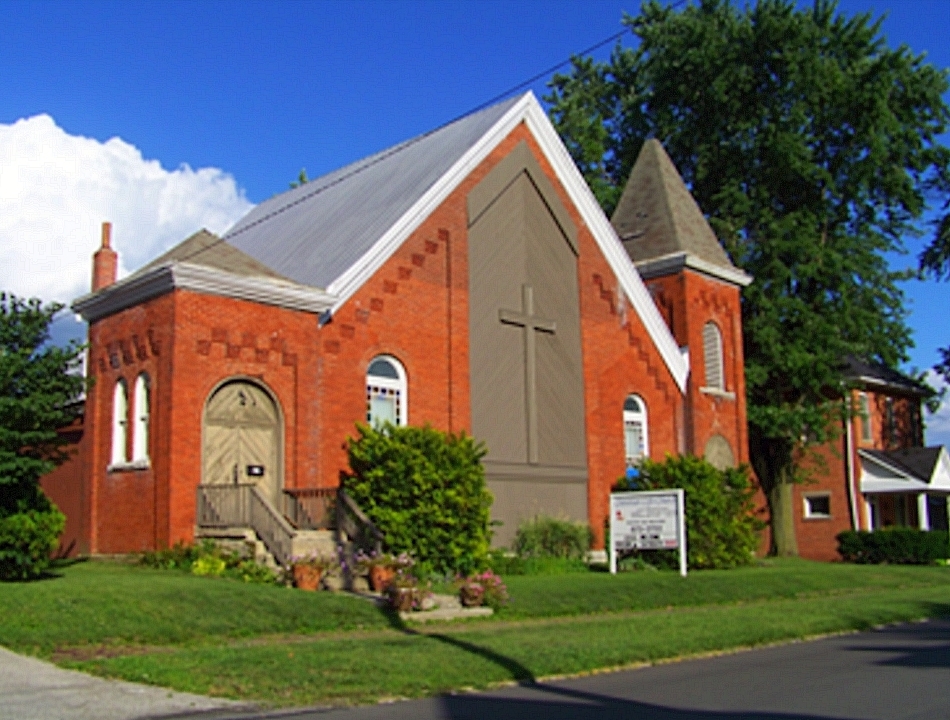
Christian Life Church Front before renovation.
At some point in time the cement “Universalist” on the front of the building was removed (perhaps with tornado rebuild) and later a new wooden façade was added, covering the stained-glass windows. Recently, water damage prompted the Christian Life congregation to remove the wooden front. Thankfully, they saw fit to restore the front to the original. It is also their plan to remodel the inside of the front wall to "let the light of God's natural beauty sign in." Unfortunately, the “Universalist” block appears to no longer exist.
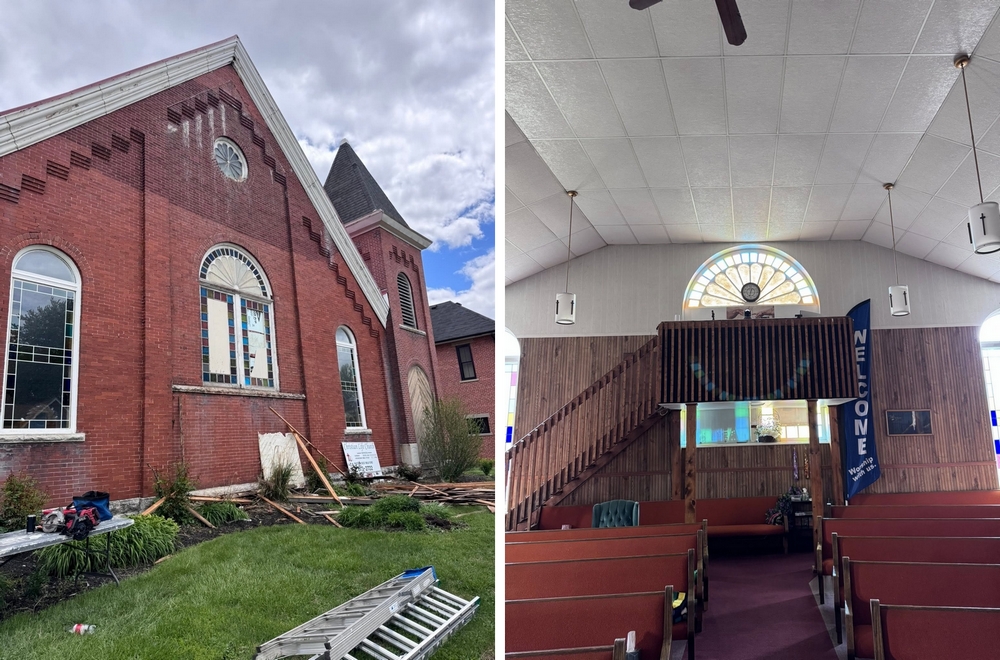
Restoration Pictures — Plans are to remove stairs, balcony and wall to open up the stained-glass to the inside.
Credit: Joan Mulford

Notes:
1. Robinson p. 147,151, 158.
In the September of 1917 Robinson was called by the Universalist church in Plain City, Ohio. It was to be a short pastorate of just two years. During the first year he shared his time as minister with Woodstock. During his second year he chose to undertake a post-graduate education at Ohio State University, desiring to earn a doctorate in American history and to write a thesis on Universalist history. However, as his ministerial pay was lacking in substance and the financial needs of a family that he gave up the dream to take on a second job as a bank teller.
Soon after coming to Ohio, the Ohio Convention appointed Robinson to the Historical Research Committee and asked him to write up the history of Ohio Universalist. That book was not finished until 1922, and published in 1923. Following Ohio, Robinson and family moved to California to pastor and teach. He died at Los Alamos, NM on Jan. 17, 1972. ("Robinson Elmo Arnold," Dictionary of Unitarian and Universalist Biography.)
2. Bryan p. 308
3. ibid p. 309
4. ibid p. 310
Resources & Bibliography:
Bryan, Chester E., Supervising Editor. The History of Madison County: Its People, Industries, Institutions (1915).
Columbus Metropolitan Library, Link
Dictionary of Unitarian and Universalist Biographies (online), Link
Gochnauer, John. Finding and posting old images of church.
Mulford, Joan, Christian Life Church, Current ImagesLink
Ohio History Connection, Link
Ohio History Connection, Link
Ohio Memory Organization, Link
Plain City Historical Society, < href="https://cdm16802.contentdm.oclc.org/digital/collection/plaincity" target="_blank">Link
Plain City History Chat,
Plain City Public Library, Link
Robinson, Elmo, Arnold, The Universalist Church in Ohio (1923).
Images
Background: 1905 Postcard
Unless otherwise noted, from the Plain City Historical Society & Plain City Public Library
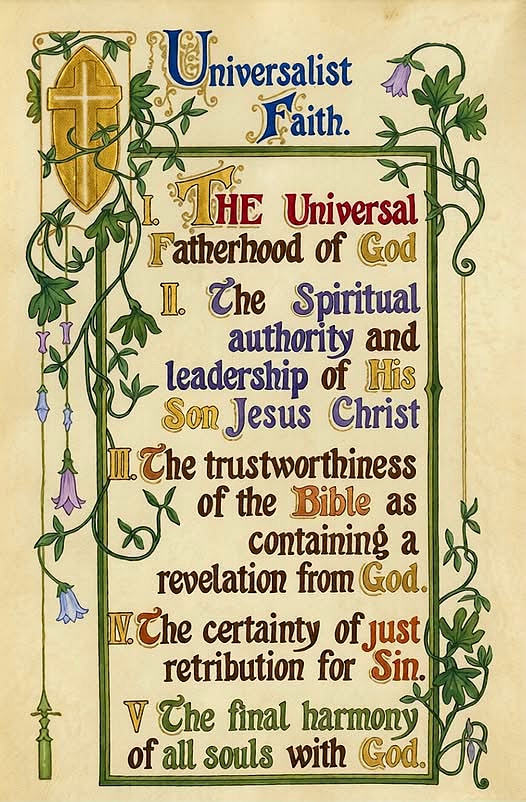
"A card presenting the Universalist "Creed" from the church
Among Universalists there were differing ways to interpret the card.
"Creed" is in quotes as the Universalist Church had no official creed.
Posted: 07.12.26
Frank A. Mills
Sheffield Lake, OH
[Church history may be updated as new information comes to light.]