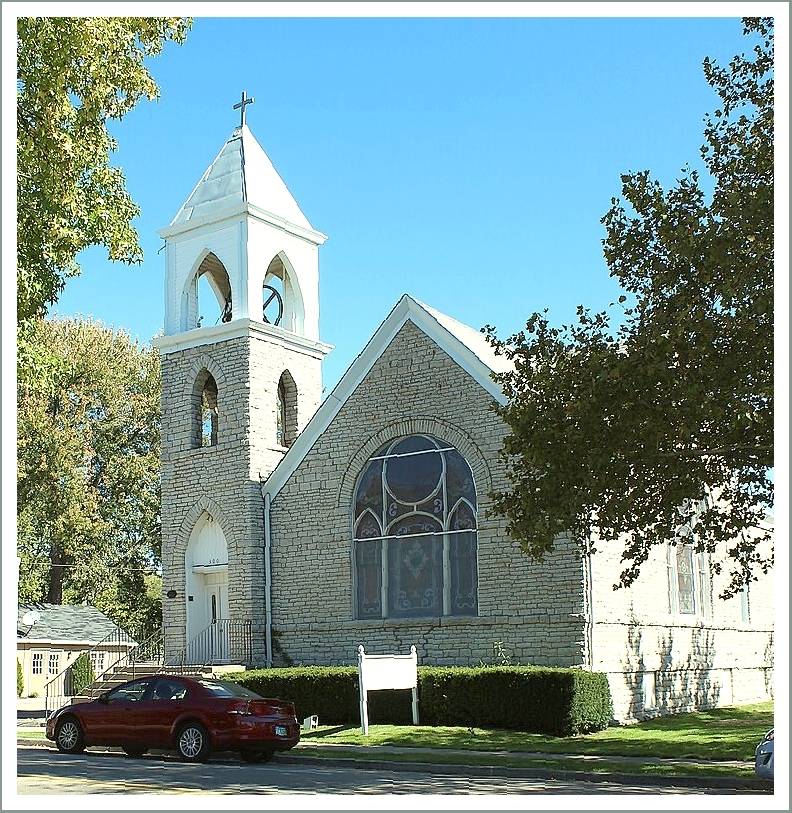
1905 Church
First Universalist Church
Universalist Cemetery
Springboro, Ohio
"Underground Railway Station"
(Warren County)
1832 – ca 1952
300 S. Main St. (Current Existing Church)
[Now Springboro Church of Christ (1994)]
Although the Springboro Universalist Society was organized in 1832, a year after Springboro’s incorporation, Universalism as a theology had been preached in the area as early as 1817 as itinerant Universalist preachers passed through the region. The earliest was probably the Indefatigable Rev. Timothy Bigelow who roamed all over Ohio spreading the message of God’s universal love. The Rev. Jonathan Kidwell, a converted Methodist also frequented the neighborhood.
In 1826 the Western States Association resolved to hold their 1827 convention at the Union Meeting House, “two miles east of Franklin, eight miles west of Lebanon.
Springboro had been settled in 1815 by Quakers. Undoubtedly the Springboro Quakers took note that many Centerville Quakers had joined with the Universalist. Some of the crowd might even had been Springboro Quakers. Whatever the case, after the Universalist Society in Springboro was organized in 1832, many of the Quaker faith joined the Society.
In 1841 the Universalists erected their church on North Main Street, on land donated by the Gregg family, who were also instrumental in the founding of the Society.3,4
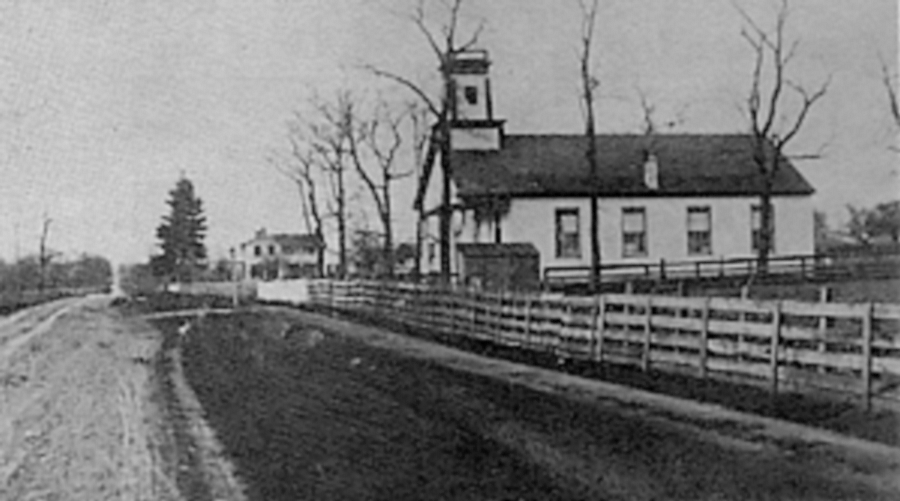
The 1841 Universalist Church
< br />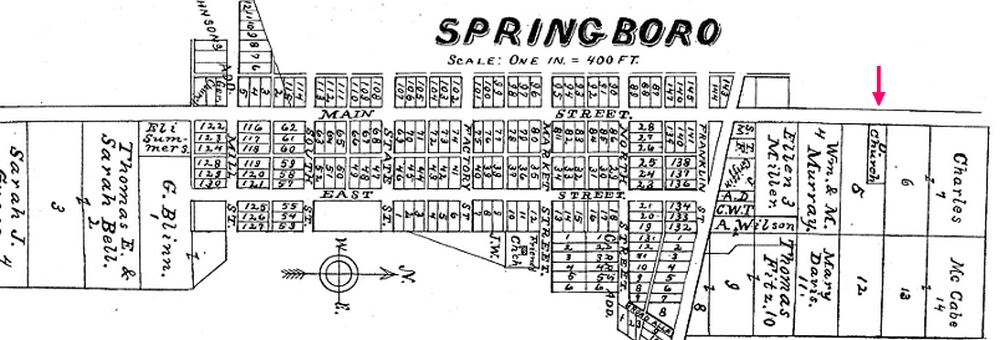
1889 Map of Springboro. Church has red arrow pointing to it.
At the dedication it is said that over 3000 people showed up, filling the sanctuary and overflowing into the surrounding neighborhood, causing the service to be adjourned to a nearby grove.5 A good bit of the crowd came out of curiosity as the theology of Christian Universalism was still relatively new to the folk of Southwestern Ohio. Yet, some were persuaded and the church prospered well into the twentieth-century.
So much so, that a larger church was needed and in 1905 the “Old Stone Church” (as the locals refer to it) was built at the corner of S. Main and E. State Streets, where it still stands today.6
That church, an impressive one, was meant to be just that—Impressive! Built of crystal-cut limestone, the Romanesque Revival Gothic Style church features a prominent steeple with a bell cupola and oversized, remarkably elaborate, opalescent stained-glass windows.
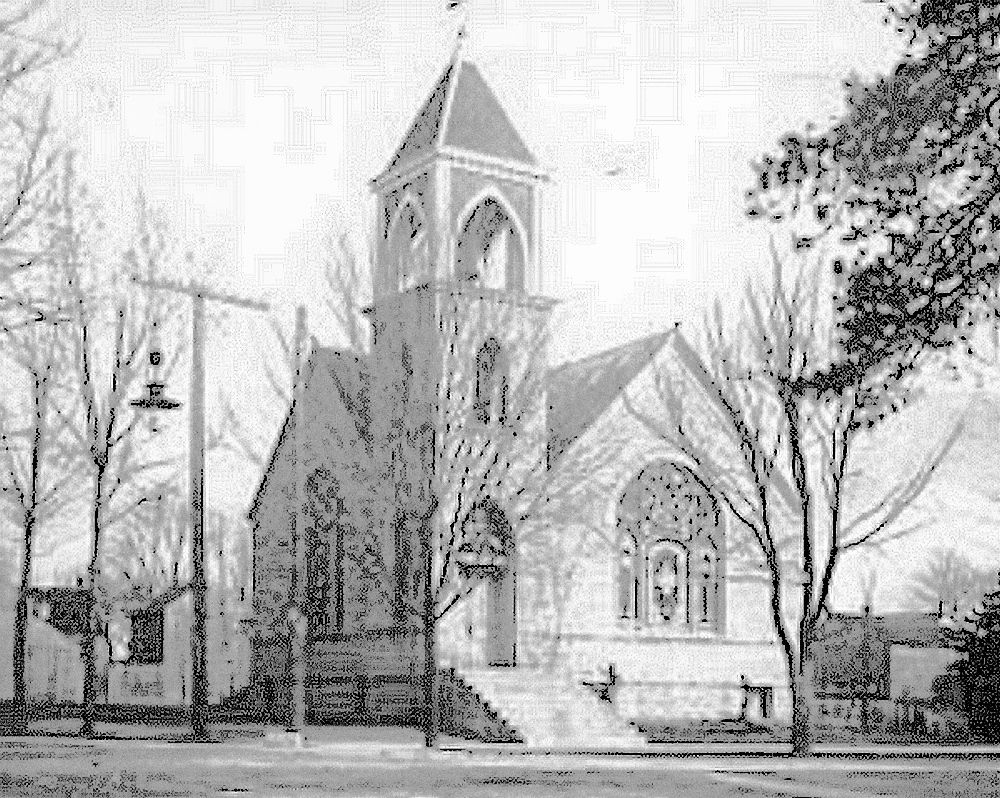
The 1905 Universalist Church. N/D
< br />
Again, the Gregg family, along with Mahlon Wright was married to Ella Gregg, and others, raised the money, and participated in the planning and building of the structure.7
For the first hundred years the First Universalist Church of Springboro prospered, growing in number and in financial stability. However, with the coming of the Great Depression in the 1930s the church entered into a steep decline. By 1940, there were only 13 members, attendance at Sunday worship, even lower. Part of the decline was due to periods when the church was without a resident pastor.8
Part of the decline can also be attributed to the fact that the theology of Universalism was becoming more mainstream. The church struggled on until around 1952 when they breathed their last breath and dissolved.
Fortunately for us, and definitely for Springboro, the story didn’t end there, or at least that of the church building. Today those who worship in the church, the Springboro Church of Christ (South Dayton Church of Christ), who purchased the church in 1917, see themselves as the stewards of the “Old Stone Church.” As stewards they have undertaken the restoration of the old Universalist stained-glass windows and the bell-tower.
We’ll come to that restoration in a bit. But before we do, we would be amiss not to comment on those better days of First Universalist Church.
The story of the church cannot be separated from Springboro’s abolitionist history and the Underground Railroad. From the first days, the Society was involved in the abolitionist movement. Springboro was settled and founded by Quakers. A faith that believed in the equality of all humans. With Quaker – and Universalist – involvement, along with her location near the border with Kentucky, a slave state, Springboro became a major point in the Underground Railway. With the Universalist theology of “Love is the way,” and that all are loved by God, it was only natural that they join with the Quakers. As a denomination, the Christian Universalists were staunch Abolitionists. It is said that the first Universalist Church was a station on the Railroad. Each of the stained-glass windows in that first church depicted one of the church’s founders, each of whom were a “stationmaster” or “conductor” on the Underground Railroad. The Rev. W. B. Linell who pastored from 1844, shortly after the first church was built, until 1851 appears to have work tirelessly on behalf the “passengers” as they moved through Springboro.
It is said that during the existence of the Underground Railroad (1830 – 1865), Springboro helped upwards to 4,000 African-Americans along their way to freedom.
Although not well-known, the first Children’s Day to be celebrated in Ohio by the Rev. J. W. Henley in the Springboro Universalist Church on Sunday, June 11, 1865. The following week, at Mt. Gilead, and on the fourth Sunday at Attica. Children’s Day was established by Massachusetts Universalist pastor, Rev. Dr. Charles Leonard in 1857.
It is always fun when in the course of research you come across a story from the “early days.” Such is this 1915 reminiscence of Hallam Stansel of her childhood days in the 1880s, or perhaps a bit before. This was the first Universalist Church. Ms. Stansel writes,
The dear old Universalist Church was next to my home. My mother played the melodeon for services. It was given to her as a wedding present by her father-in-law Jeremiah Stansel. She carried it every Sunday from our home to the church. Grandpa Jeremiah lent his grand voice to the singing of 'Lift Up Your Heads, 0 Ye Gates.' I was a tiny girl, but very impressionable. When we left Springboro, my mother's mahogany furniture became church furniture. I never had a desire to take it from that sacred place where on the pulpit in letters of gold on a field of blue were the words, 'God is Love.'9
First Universalist hosted the Ohio Convention of Universalists in 1841 in the new church, and in 1860. She also hosted the 1841, 1893. 1898, 1905, 2011 (?), 2012 and 2019 Miami Association Conventions.
The church is part of the 50 acre, Springboro Historic District, containing over 100 historic buildings, may related to Springboro’s role in the Underground Railroad. The district was added to the national register in 1999.
Stained-Glass Windows
We now come back to the stained-glass windows: As previously noted, many of the stained-glass windows in the old wood-framed church memorialized the founders of the Springboro Universalist Society. When the new church was erected in 1905 the windows were carefully removed and installed in the church.10
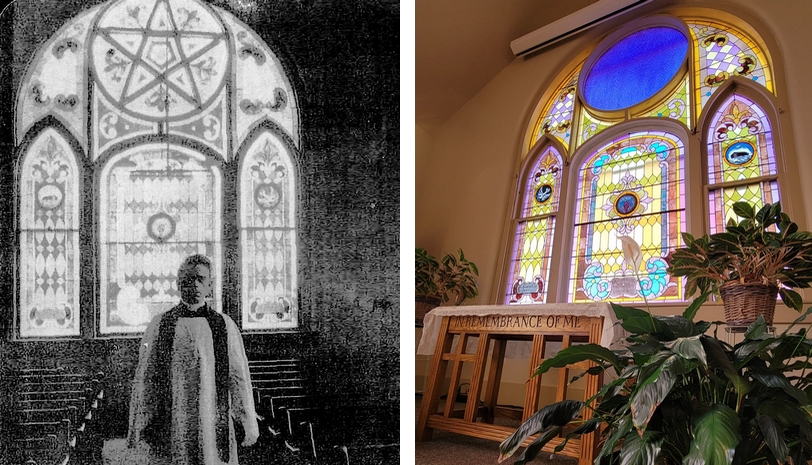
1905 Universalist Church with and without 5-pointed star. N/D
Minister not identified
When moved some of those windows gained a five-pointed star. However, by the time Springboro Church of Christ decided to restore the windows the stars had been removed. In fact, they had been missing from sometime in the late 50s or early 60s. Why were they removed?
Five-pointed star in Christian circles were widely used to depict the Star of Bethlehem or to link Christ to his Hebraic lineage, to signify his five wounds on the cross, or perhaps all three. By the time a new denomination moved into the church, the five-pointed star had taken on pagan and satanic connotations. Finding this offensive to their sensibilities, the stars were removed. However, believing that the windows as they were originally are an important part of Springboro history, the Springboro Church of Christ lovingly restored them.
Bell Tower
The Bell Tower dates to 1905 and is considered one of Springboro’s most iconic landmarks. Over time the tower became structurally unsound. To save the tower, the Springboro Church of Christ decided repair the bell tower. Stripping the sheet metal roof and vinyl siding exposed ab exquisite fish-scale siding and a cedar-shake roof. Seeing themselves as stewards of both the church and Springboro history, the church took it upon themselves to restore the bell tower to her original 1905 craftsmanship. The church and the community rallied together to raise the more than $100,000 necessary to complete the project and return the bell tower to her original perch in 2023.
The church was recognized with the 2024 Johnathan Wright award for the preservation and restoration of the bell tower. The restoration was undertaken by Springhouse Architects, Springboro.
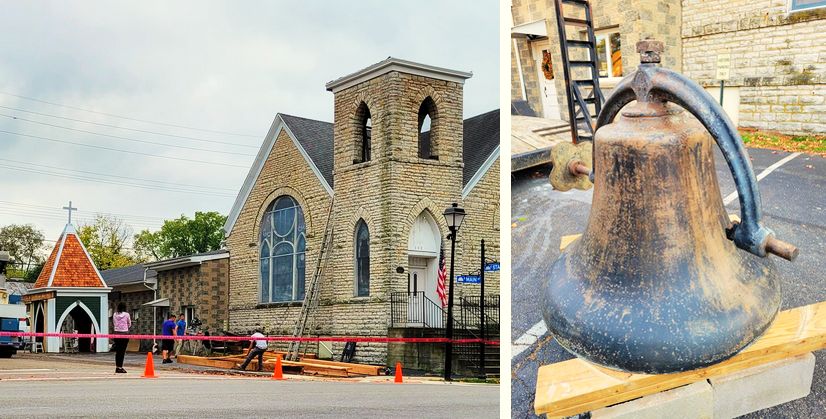
Bell Tower Removed (Waiting to be reinstalled) & Original Bell
The Springboro Universalist Cemetery
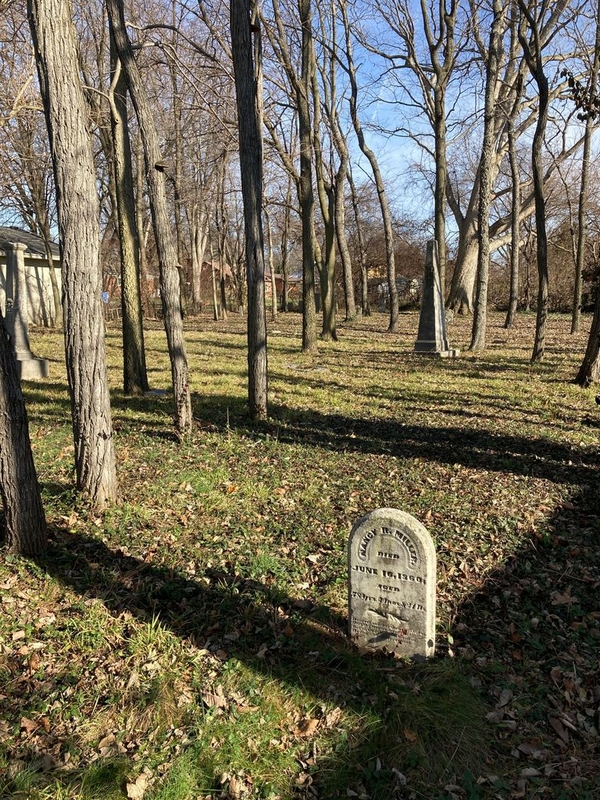
Springboro Universalist Cemetery
Credit: KDB, "Find A Grave"
The cemetery is a small, inactive burial ground located behind 70 N. Main St. commercial properties. When established in 1837, the cemetery was on land donated by the Gregg family, located behind the soon to be built church. The first burial, in 1837, was Nicholas Fye, a member of the Universalist Society.
The cemetery quickly filled, sadly a large number of the burials were children. Many of those buried were victims of typhoid fever. By 1850, the cemetery was almost 50 percent filled. Fifteen or so years later the cemetery was almost completely filled. The last official burial was in 1867.
Through the 1920s the Universalists lovingly maintained the burial ground. However, with declining membership in ‘30s and 40s and the church’s dissolving in the ‘50s the cemetery was abandoned. In 1992, when volunteers began to restore the cemetery, it was described as, “Dense bushes, noxious weeds, sun-starved saplings and several large trees effectively filtered out all but scattered shafts of light, even at midday.”11 During the initial restoration about 60 grave markers were restored.

Partial List of Ministers:
The names come from church and Association records and are not always accurate. The date given in the records is often when they first preached in Ohio, If the Springboro dates are known, they are listed. Frequently an early minister is mentioned in a history, but his or her name is not in the Association records.
Rev. W. B. Linell, D. D.: 1844 – 1851
Rev. J. W. Henley: Introduced Children’s Day to Ohio at the Springboro Universalist Church on Sunday, June 11, 1865. There is no mention of him as minister in Springboro. He however, preached at Mt. Gilead and Attica as part of a preaching circuit. It would seem reasonable to include Springboro in that circuit.
Rev. Jacobs: No first name listed in the 1870 Census as preaching in Springboro.
Rev. Dewitt Lampherar: Born in Rome, N.Y., Studied at Buchtel College (founded by Universalists, now the University of Akron), ordained in Springboro in 1881.
Rev. John Richardson: Licensed and ordained by the Ohio Convention in 1886. Preached in Springboro.
Rev. Ira A. Sharon, D. D., at the “turn of the century” served at Springboro.
Rev. Clifford E. Jones: In the summer of 1894 began preaching in the Western Reserve. Left Ohio and returned in 1896. Preached in Springboro for a short time, as well as in Mason and Ridgeville, Kent and Ravenna. Moved to Massachusetts in 1903.
Rev. J. L. Silanton (sometimes A. L.): Began preaching in Ohio in 1902, preached at Springboro for two years.
Rev. Frederick Waldron Evans: From Massachusetts, ordained in 1892. Preached in Springboro, Cuba, Hamilton, Mt. Carmel and Milford sometime after 1908.
Rev. William Ezra Leavitt: Born in Ontario, educated at St. Lawrence (N.Y.) and ordained in New York in 1890. Preached in Springboro, Summit, Jersey, and Mason.
Rev. Manfield Johnson: Preached in Springboro around 1913.
Notes:
1. Universalist Convention of the Western States Jacksonburgh Nov. 24-26 1826
Resolved, That our next Convention (1827) be held at the Union Meeting House, two miles east of Franklin, and eight miles west of Lebanon, Warren County, Ohio, commencing on the Friday preceding the second Sab¬ bath in October next, and to continue three days. Robinson, p. 88.
2. Ibid, Robinson, p. 81
3. “Mr. William Gregg was raised and instructed in the doctrines and discipline of the Society of Friends, but about the year 1840 he embraced the doctrines of Universalism, and was one among the first to form a society in Springboro for the building of a Universalist Church; he died March 2, 1879.” Biographies with Warren County Connections, P. 906.
4. About where Chung’s Academy of Martial Arts is now) on land donated a portion of lot 5, 1891 plot map)
5. "History of Warren County" (2004), Warren County GenWeb,
6. Robinson has the church being replaced by a new church in 1896. However, the second church was completed and dedicated in.1905. It is possible that the date refers to a remodeling, or perhaps the date the congregation decided to build a new church, or it is merely an error.
7. Mahlon Wright (1807–1877) was a prominent figure in Springboro, Ohio, and the son of the village's Quaker founder, Jonathan Wright. A state legislator and postmaster, he operated a vital Underground Railroad safe house and ran a local general store, cementing his family’s massive historical impact on Warren County.
8. By the 30s, Springboro often did not have a “seated” pastor was part of a multiple church circuit served by a single pastor.
9. “The Universalist Church & Cemetery.”
10. Clearcreek DAR has prepared a history of the windows and the families who donated them - “Windows On the Past.”
11. Paths Through the Wilderness p. 90
Resources & Bibliography
"History of Warren County - Churches" (2002). Warren County GenWeb.
Robinson, Elmo Arnold, The Universalist Church in Ohio (1913), Ohio Universalist Convention.
Ross, Don, Paths Through the Wilderness (n.d.).
Springboro Area History (2022).
Springboro Church of Christ.
The Sentinel & Star in the West (Universalist newspapers). Archived copies available online from the Hathi Trust Digital Library
Images
Images of the stained-glass windows, the background image and current church courtesy of the Springboro Church of Christ.
Images of the bell tower construction, courtesy of Springhouse Architects.
[Posted: 07.01.26]
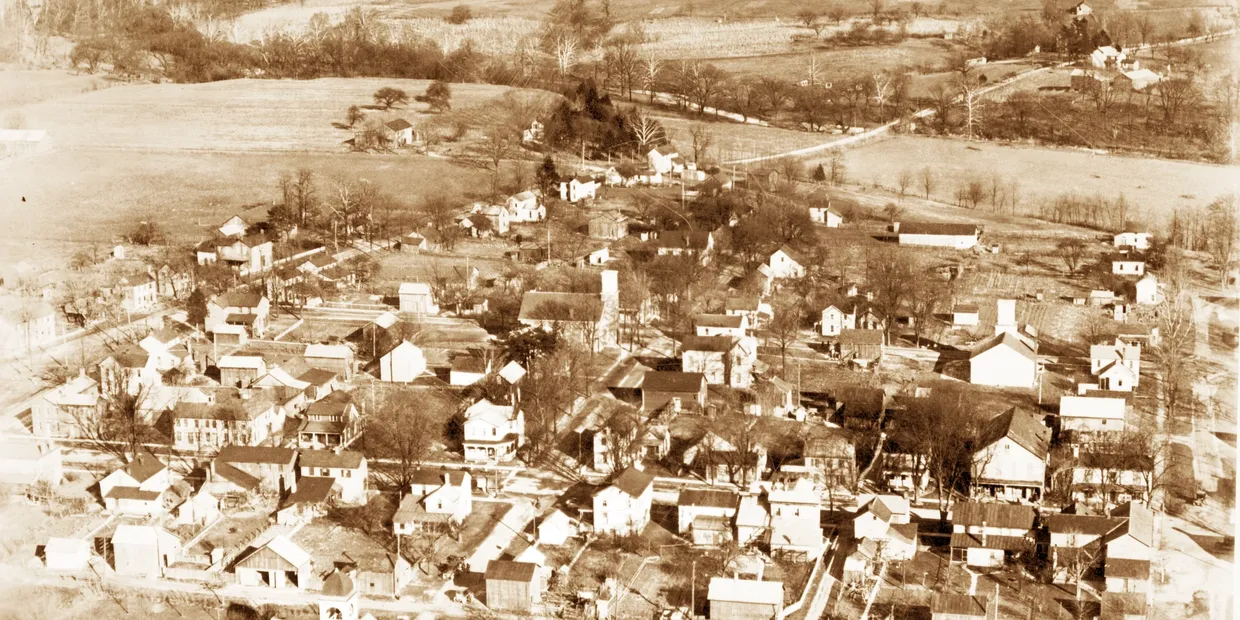
The Universalist Church is the church with steeple on right side of picture. The open space behind the church is the cemetery.
[Church history may be updated as new information comes to light.]