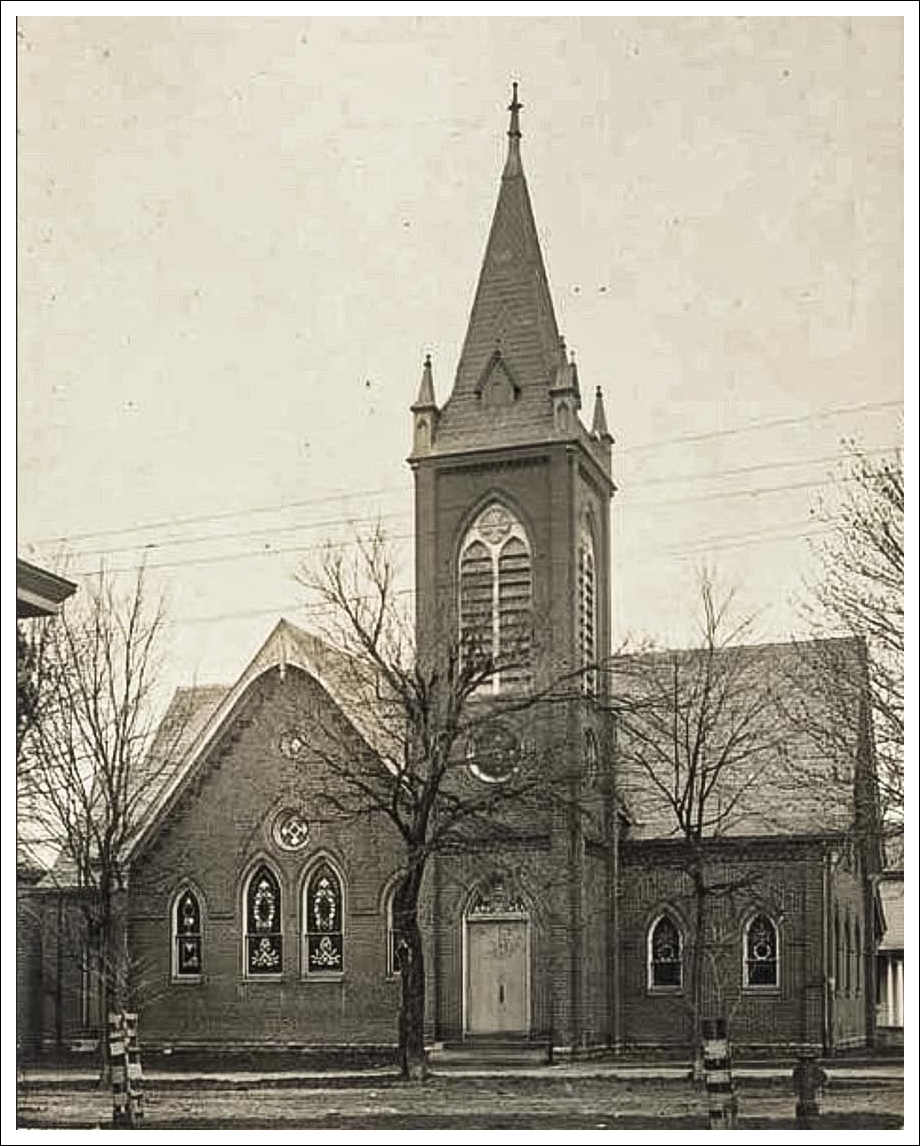
First Universalist Church, Blanchester
[Clinton County]
ca. 1907-14
Corner E. Main & N. Wright
Built: 1893 | Demolished: 1969
First Universalist Church
Blanchester, Ohio
1835 – ca. 1965
The story of First Universalist Blanchester is the story of two churches, one that lasted into the 1960s.
It all began in Edwardsville
The First Universalist of Blanchester began four miles to the north in Edwardsville as the Universalist Society of Toddsfolk.1 Situated on the C&C Turnpike (Cincinnati – Columbus) Edwardsville was a logical location for the area Universalists to meet.
Although they might have meet earlier, 1832 is the first mention of any Universalist gathering. In 1835 they organized as the Universalist Society of Toddsfolk, making them the first official Universalist group in the area. Two years later, in 1837 they reorganized as a church, and the following year, built a church in Edwardsville.
The society was likely organized in part by a “Gen.” Benjamin Baldwin1b who lived nearby and whom Robinson describes as:
(A) reliable friend of liberal principles. He was an intelligent and influential man, and devoted to our cause. He was one of the first to make an effort to establish Universalism in Southern Ohio. Although a layman he often spoke in public in its defense. Subsequently he moved to Illinois….2
Baldwin served in the 2nd Brigade of the 1st Division of the Ohio Militia during the Civil War. The Company was composed of militia units from Warren and Clinton Counties.
At about the same time the Universalists began meeting in Edwardsville the Rev. Erasmus Manford, a circuit rider, preached near Edwardsville. Manford’s letter suggest that he did so at the invitation of Gen. Baldwin.3
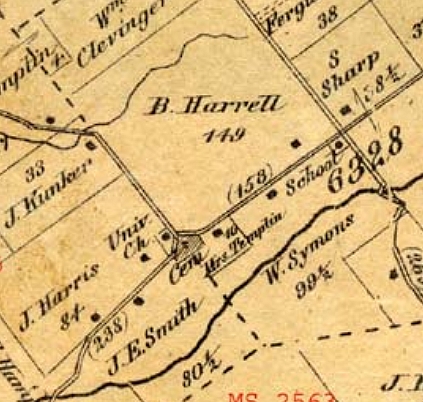
Map of Edwardsville showing the Universalist Church
Across the street from the church sits a cemetery, quite possibly connected to the church.
With the pending arrival of the railroad (1852), members began moving into Blanchester to be nearer to the railroad and the businesses that arrived with it. For the first few years, the Blanchester Universalists held services at the schoolhouse that then faced W. Center St. In 1852 the Blanchester Universalists incorporated and in the same year built their church. It wasn’t until around 1867 that the name, First Universalist Church was adopted.
It appears that the church in Edwardsville continued after the split, at least until the 1890s. Ministers are recorded as preaching in both places, and we do know that the Rev. Samuel G. Dunham preached at both locations in the early ‘90s. Edwardsville continued to be listed in Convention records into the 1920s.
A Dilemma
A bit of history that often gets overlooked is why the Blanchester Universalists decided to build a church and the why of the rush to build it.
The Ballou Association of Universalists4 had scheduled their 1852 convention to meet in Blanchester. After much unfruitful discussion about where to hold the convention, it was decided to build a church on a lot at the corner of E. Main and N. Wright (where the First National Bank is now) donated by Judge William A. Baldwin.
The church was constructed in seven weeks. The seats were borrowed from Edwardsville, and the convention was held before the walls were plastered. Quite a feat to build a two-story brick edifice in that short of time. The upper floor was the sanctuary and the lower floor was divided for Sunday School rooms. In 1856 the church was dedicated as part of a 4-day meeting during which the church gained several new members.
These extended meetings were a mixture of “revival Service” and homecoming, with much preaching, entertainment and food. The food almost always prepared by the “church ladies.”
Judge Baldwin was the first Sunday School Superintendent and held that position until his death in 1862. For a brief time in 1854 the lower floor served as classrooms for the Blanchester City Schools. In 1873 the church was rededicated.
In 1886 the church underwent a remodeling, including two stairways between floors. The rooms on the first floor were used as for the mayor’s office, council chambers, fire engine house, and J.B. Baldwin’s agricultural implement store.
Rebuilding
A few years later, in 1892 it was decided to tear down the old church and rebuild it using as much of the old church as possible. The cornerstone was laid in 1893 with roughly 700 people in attendance. The cost of the new building was $11,000. The new church seated 500 people. Presumably, it was at this time that the landmark steeple was added. The church was the location of many high school activities during the 1920s.
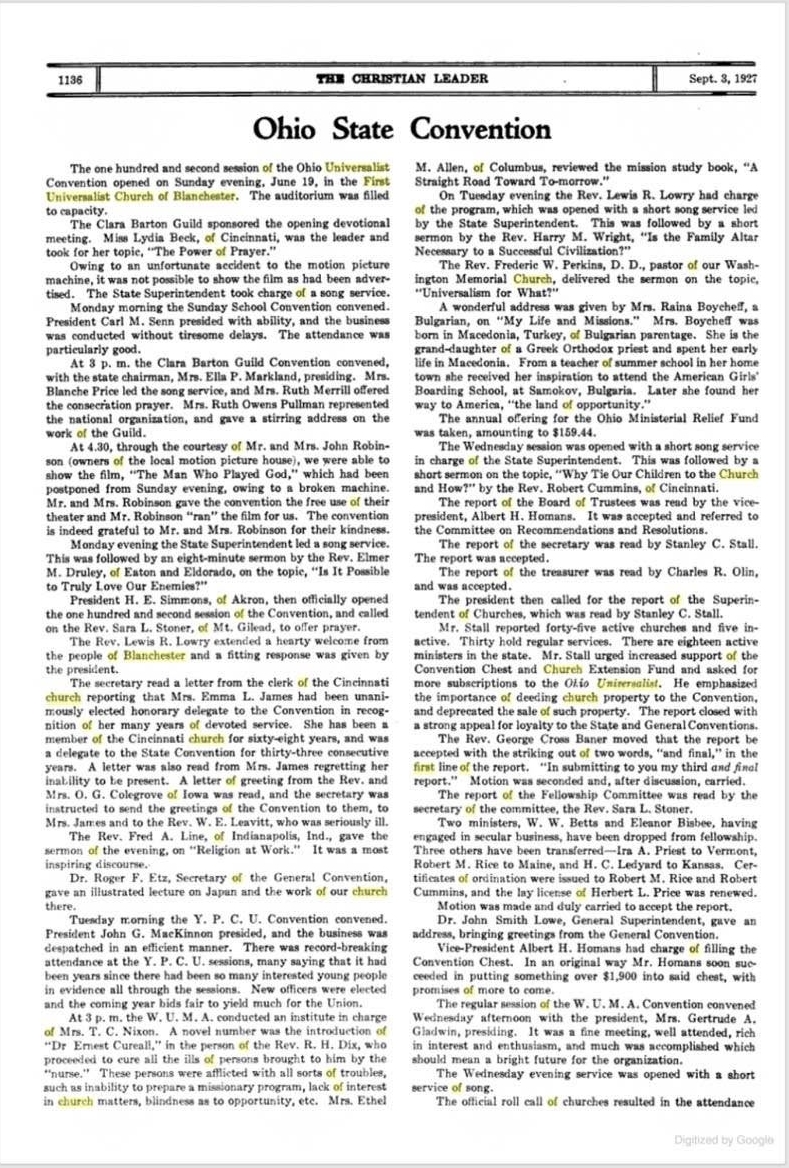
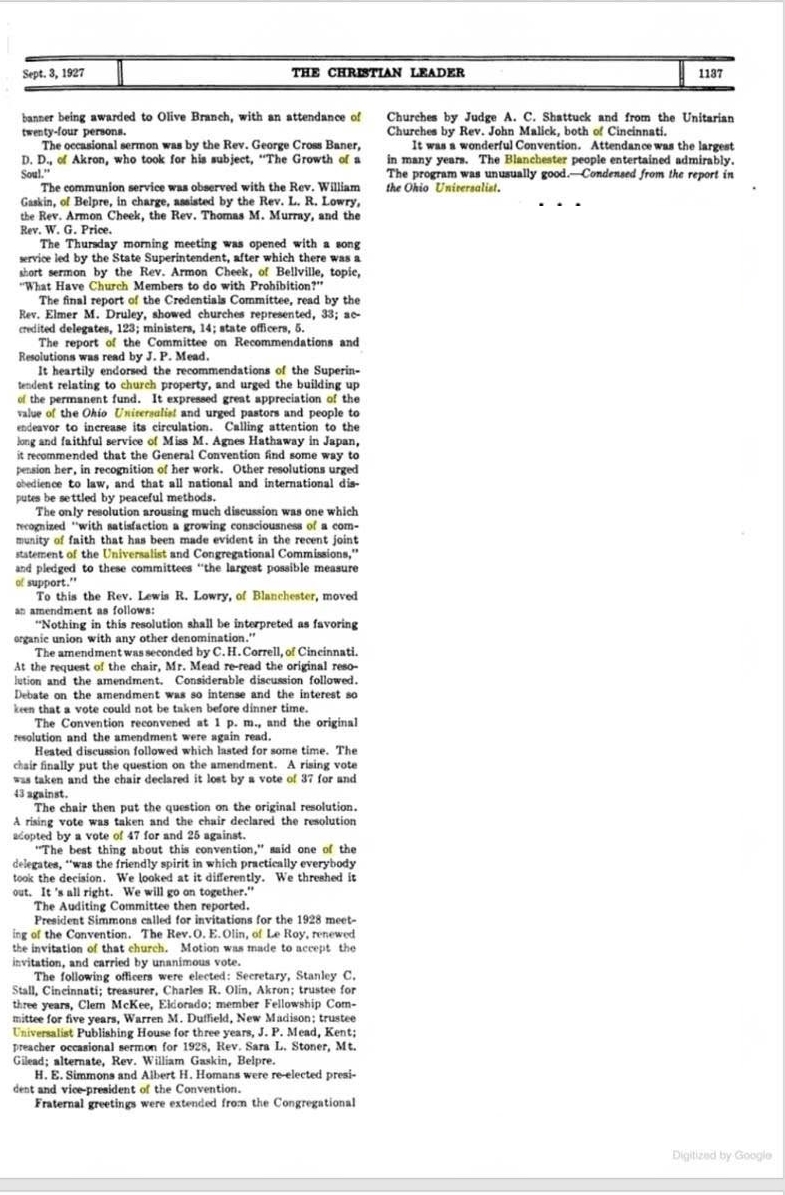
On June 19, 1927, the Blanchester Church hosted the 102nd Ohio State Universalist Convention. The Christian Leader,5 at the time, reported that the Convention was the “largest in many years” and that the Blanchester people entertained admirably.” A film had been advertised, but unfortunately the projector broke and a rousing song-service was held in its place.6 A business item at the Convention was to discuss what sort of relationship the Ohio Convention of the Christian Universalist Church should have with the Congregationalists. As the Christian Universalist Church had her roots in Congregationalism, and because Universalist Churches were congregational in organization, such consideration was reasonable.7, 8 The ultimate decision was to maintain cordial fraternal relations, but not to enter in any formal relationship. Many of those present spoke forcefully against all formal relationship. Both the Congregationalists and the Unitarian Churches sent fraternal greetings.
At the time the church was described as:
As a church, the Universalists still followed the precept of their forebearers; believing in the fatherhood of God; the Brotherhood of Man and the final harmony of all souls of God; the Golden Rule was their guide. The ladies of the church worked hard serving dinners and luncheons to make money.7
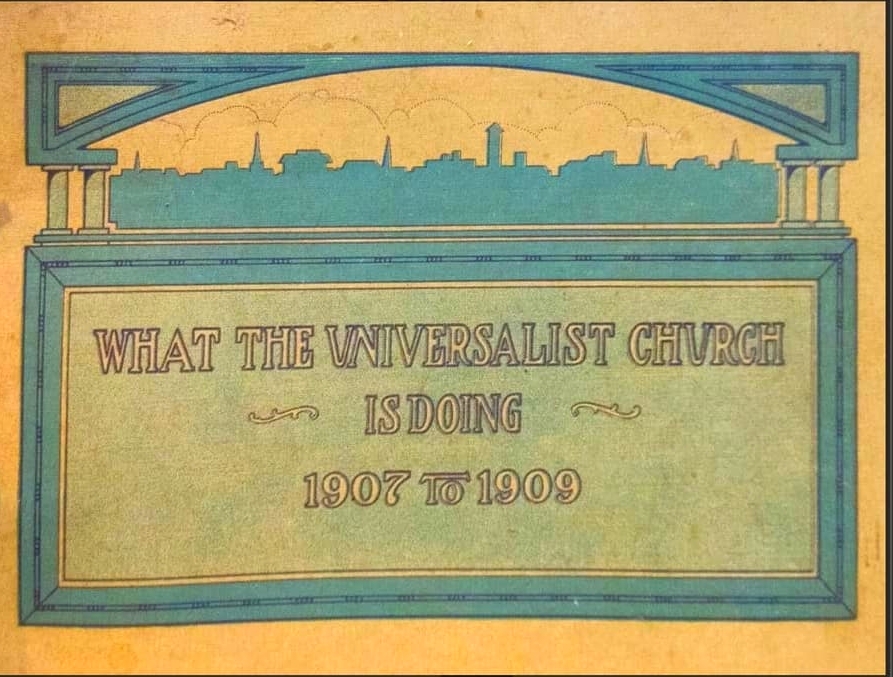
1909 Brochure Cover
The End
Although the church was demolished in 1969, on August 5, 1960, the Wilmington News Journal reports it to be in a “flourishing and prosperous condition with 134 members.” The article also noted that the society had no debt and a constant income from the rentals. The church is listed in the UU merger, but apparently was without a minister, which can be deadly for a congregation’s growth.
Wrapping it Up
During her existence the church had a succession of ministers, some serving as supply, some lasting only a short time, and some, serving for several years. Among that number were Dr. W.R. Rowlandev and R.S. Kellerman. The Universalists as a denomination were early to ordain women to the ministry. Blanchester had at least one female minister, the Rev. Harriet I. Baker Robinson (early 1900s).
Throughout here years many of Blanchester’s prominent residents were members of the church, including Robert Newman John (an ordained Universalist minister) who served in the city’s early years as the superintendent of the Blanchester Public Schools.
Final Note
I was told by one person that the church was haunted, supposedly by a disgruntled minister. Noone else that I talked with a heard this. The Church is not listed in “Haunted Places of Clinton County.”
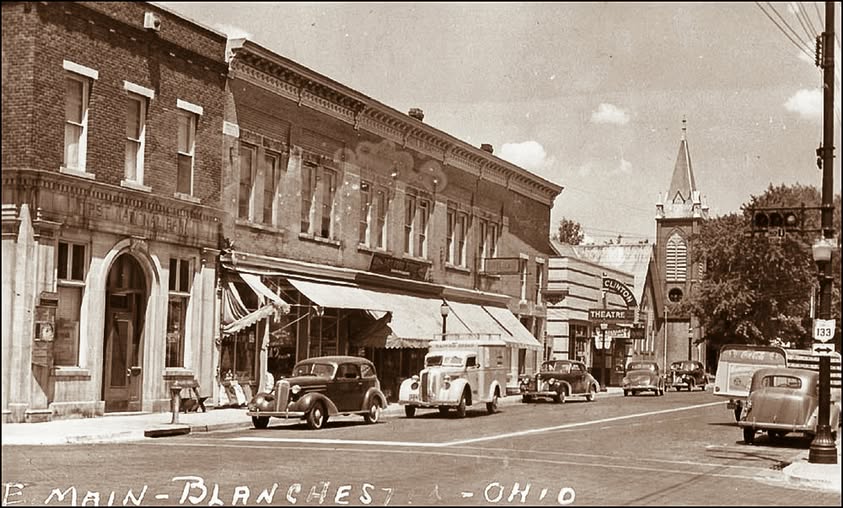
Blanchester ca 1938
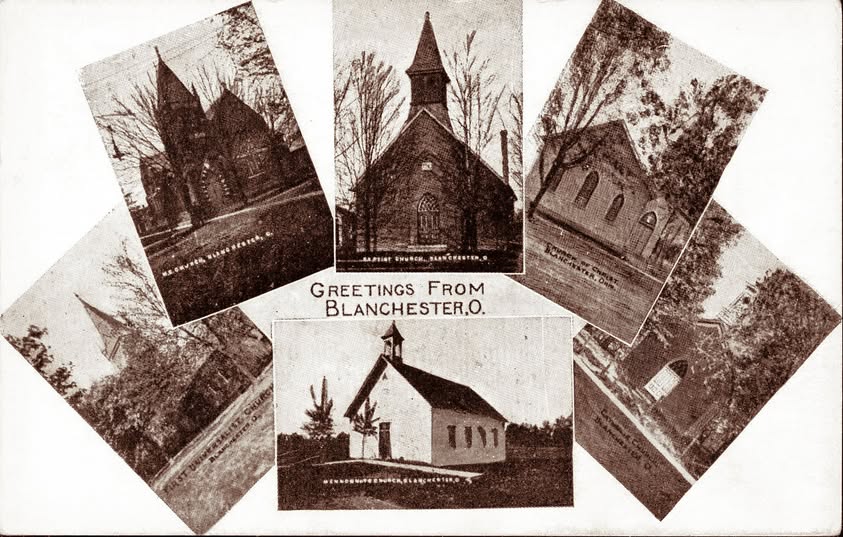
Blanchester Churches Postcard - Universalist Church Far Left

Notes
1. Some records misspelled "Toddsfolk" as "Toddsfork." I have been unable to determine the source of this unusual name. One possibility is that is a misspelling of "Todds Fork" that stuck, as the East Fork of Todd's Fork was nearby. In any event, church records have it as "Toddsfolk."
1b. Gen. Benjamin Baldwin was also one of the early settlers in Harlan Township. He was the son of Samuel Baldwin, who came to this township very early. H.N.Baldwin, as he was generally known, was perhaps the most prominent of the early settlers, and it is a matter of regret that so few dates and facts regarding, For several years he was commissioned and served as a general in the Ohio Militia. He was elected and served several terms as Justice of the Peace. He was elected as tire Jacksonian candidate as the representative of this county in the Ohio Legislature, of which body he proved to he a valuable member. In was in 1834 he was appointed and commissioned one of the Associate Justices of the Common Fleas Court for Warren County.
He was a man of more than ordinary abilities, of superior natural attainments and possessed of those qualities and honesty of purpose which made him an honored and valuable member of the community and period in which ho lived. [History of Warren County, Ohio 1882.]
2. Robinson, p. 39
3. ibid.
4. Originally part of the Miami Association of Universalists, which was formed in 1835. Due to the size of the Association and the time to travel to meetings, in 1842 the Association was divided into two with the Miami R. being the separating point. The new association became the Ballou Association, which included Blanchester, Milford, Mt. Carmel, Cuba and Farmer's Station.
5. A Christian Universalist newspaper.
6. The Universalists were among the first denominations to incorporate motion pictures into their activities.
7. In the early days of Christian Universalism, Universalists saw the doctrine of universalism that taught all souls would ultimately find harmony with God as a "happy" or better version of Calvinism, which taught that only the elect would do so. This Calvinism was the teaching of New England Congregationalism where Christian Universalism had her roots.
8.Universalist churches were adamantly congregational in structure. They resisted any form of denominational structure that would limit their independence. Thy were organized by Convention, which was mostly a loose affiliation of Universalist Churches. As Universalism matured as a denomination, more structure came with it.
9. Wade, Lillie B., Blanchester Area Heritage. Mrs. Wade was a long time member of the church who served as Sunday School Superintendent for many years.
[All Images: Blanchester Historical Society Used with permission.
Map: 1867 Wall Map of Warren County, Harlan Township, Warren County Ohio Gen Web.
Bibliography
- Blanchester Area Historical SocietyBlanchester Area Heritage (1994). Curless Printing Company, Blanchester, Ohio
"Credit given to Lillie B. Wade for writing much of this history many years ago with updates by Ethel J. Lyttle."
- "Blanchester, Ohio. First Universalist Society of Blanchester. Records, 1835-1921" Harvard Library Archives
- Christian Leader, The, September 3, 1927, pp.1136, 1137.
- History of Warren Counry, Ohio - 1882. W.B. Beers & Co.
- Robinson, Elmo Arnold, 1923, The Universalist Church in Ohio. The Ohio Universalist Convention.
[Posted: 06.06.26]
[Church history may be updated as new information comes to light.]