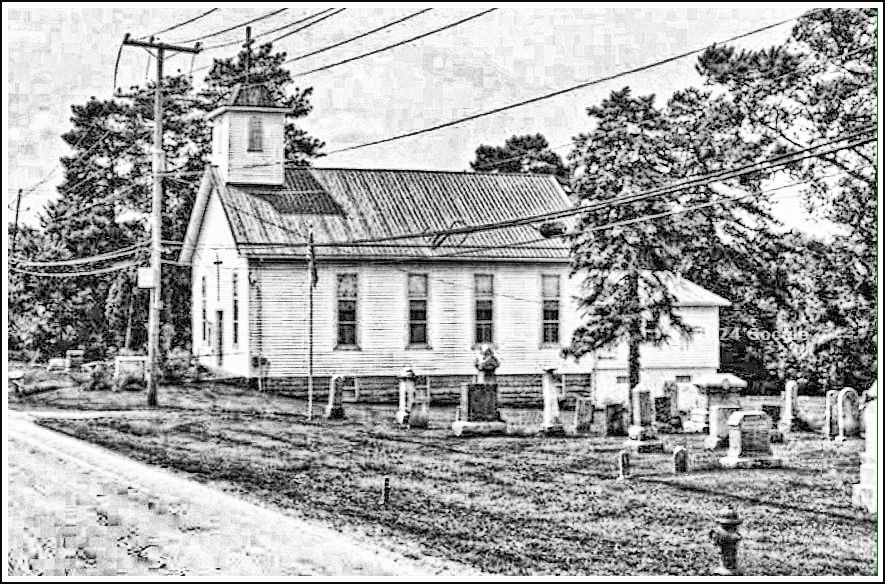
Jersey Christian Universalist Church & Cemetery
Jersey Christian Universalist Church & Cemetery
Jersey, Ohio
(Licking County)
Location: 13134 Worthington Rd. (Jersey Township, Pataskala, Licking County).
Architectural Style: A classic example of Greek Revival architecture, characterized by its simple, symmetrical design. A style typical of many early American rural churches.

[Updated: April 26, 2026]
MAJOR UPDATE IN THE WORKS: Just recently, thanks to Elizabeth Bowman of the Licking County Historic Society I received a treasure trove of photocopies of several newspaper clippings related to the church, along with some photos. In addition, Tyler Freese, Jersey Township Roads and Cemeteries Director provided me with a contact number, who turned out to be non-other Willis Fravel's widow, Ellen Fravel. Mrs. Fravel and I will be getting together soon. I expect to hear some great stories. She promised to show me some of the church memorabilia too. While there I plan to take some photographs to round out the visit.
Ice Cream Socials to die for! A “romantic location full of friendly, sociable folk.” Noble trees, guardians of a beautiful “Sabbath home” for a “devoted, happy congregation.”
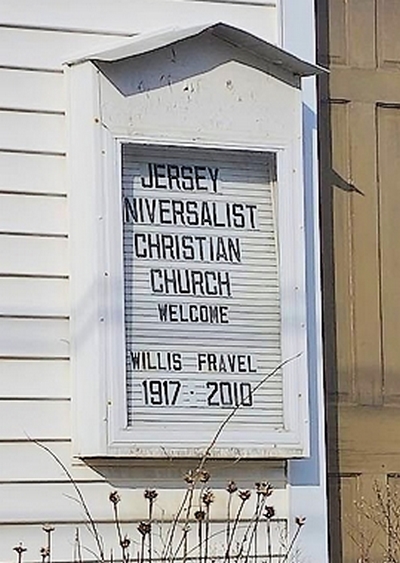
The ice cream social to die for are from more recent day. The rest is E.M.P Brister’s 1909.1 description of the Jersey Universalist Church. And it must have been so, for we are told that the church lasted longer than most of Ohio’s Universalist Churches—if the church sign is to be believed, 2010.
The ice cream socials? Will Humphrey who a while back was the minister at All Souls in Bellville, tells me that the face of one of his old-time members would light up when he talked about the Jersey Church’s ice cream socials. It seems that the social was so popular that Universalists would drive over from Bellville and Attica, as well as from others. I suspect that not all in attendance were Universalist.
2024 | Scott Sloan
Although the church signboard claims 1917, which might be confused as a beginning date for the church2, the congregation is quite a bit older than that. The “happy and devoted” gathering of Jersey Universalists began in 1824 in Michael Beem’s cabin. Quickly outgrowing the cabin, they took over Beem’s barn for Sunday Worship. The first minister of record was a Rev. Curry. Undoubtedly, before Rev. Curry, at least one itinerant Universalist minister called up the Jersey folk. Brister tells us that the Universalist message appealed to an “intelligent class of farmers. 3”
By 1829, the congregation had grown enough to become formally organized and “Fellowshipped” by the Central Association of Universalists. The Rev. Truman Strong, a leading “Universalist Evangelist” was called as pastor. That Rev. Strong accepted the call speaks well of the quality of the congregation. Rev. Strong served until sometime in 1833, and then returned to the Jersey pulpit in 1837. In the years between, the church was served by Rev. Henry Jolly.
Shortly after Rev. Strong returned, the growing congregation began to construct a new edifice located about two miles east of the little hamlet of Jersey. Construction was completed in 1840. The same year, a Sabbath School was begun.
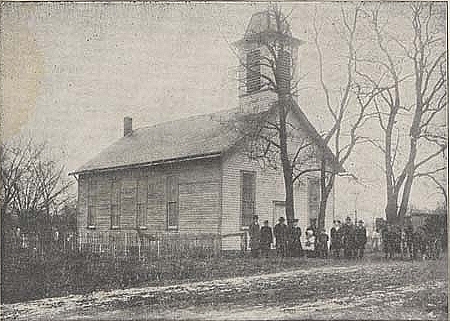
Between 1840 and 1887 the congregation continued to grow, necessitating the need for a larger church. Built on the same grounds as the old church, for a little more than two thousand two hundred dollars, the church was dedicated, debt free, on August 4, 1887. A notable roster of preachers filled the pulpit on that day – Rev. W. M. Jones of Columbus, the Rev. J. S. Cantwell D. D. of Chicago, Rev. N. R. Quackenbush (pastor) and Rev. H. L. Canfield, D. D. By all accounts, O. P. Merrill led an excellent choir. And I am sure the Ladies Aid Society served up an excellent repast. Brister comments that the church seated a little over 300, with a gallery over the front entrance. During this period, the church was home to a well-attended Sunday School, an active junior Y.P.C.U and a committed Ladies Aid society. 4, 5
One interesting note made by Brister is that the church had remained debt free at least until the time he wrote (1909). In 1894, the Jersey Church hosted the Central Association in their “new” church (also in 1906, 1910, 1914, 1918).
With the merger of the Universalist Church of America and the Unitarian Church of America, the Jersey church opted to remain out of the merger; subsequently affiliating with the National Association of Congregational Christian Churches.
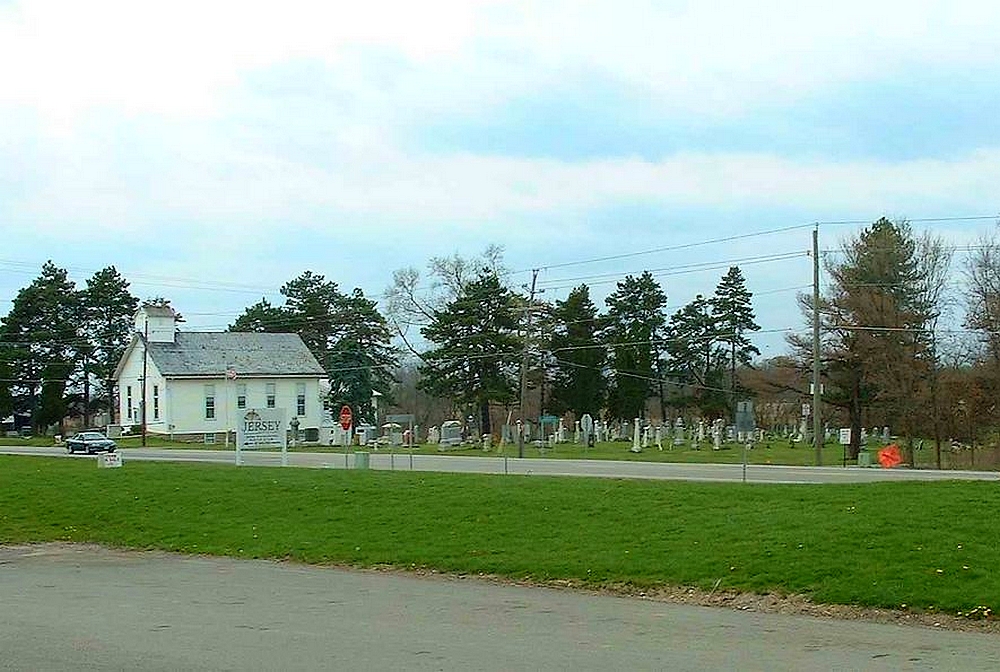
While today the Jersey church no longer hosts regular services, it does continue to hosts reunions and the occasional service. But not all that long ago, the church was hosting ice cream socials and even more recently holding regular worship services. Today the church is preserved (and owned) by the Fravel Family Trust.
Undated | Cave Naylor
The Jersey Universalist Cemetery came under Jersey township control in the 1930s, and has no plots available. The earliest burial date is Feb. 6. 1832, Catherine Rhodes. As this precedes the building of the church it may be that the family of the first person buried gave or sold the land to the church, or that perhaps the church, after organizing, purchased the land several years prior to building, anticipating the need for both sanctuary and cemetery. The surnames, Rhodes, Beem and Meyers appear frequently in 1832 and later. These names were associated with the church. Although the last burial is not until 1991, it appears that in the 1950s burials pretty much ceased.
Like all good histories should, researching the history of the Jersey Universalist Church set me off on another direction.
In 1839. A year before becoming clerk at Jersey, C. Cook was clerk at “Brother Perry’s” in nearby Delaware County. As 1839 is the last year Robinson in his Universalist Church in Ohio mentions “Brother Perry’s,” I am wondering if that group is in some way connected with that of Jersey? There is, as far as I can find, no record of a church that corresponds with “Brother Perry’s.”
Post Card (n/d) | Harvard Divinity School Library Archives
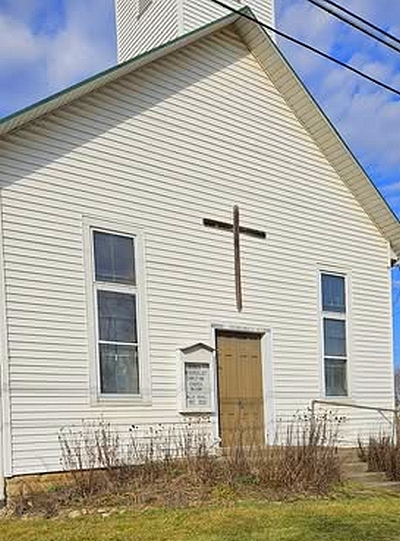
2024 | Scott Sloan
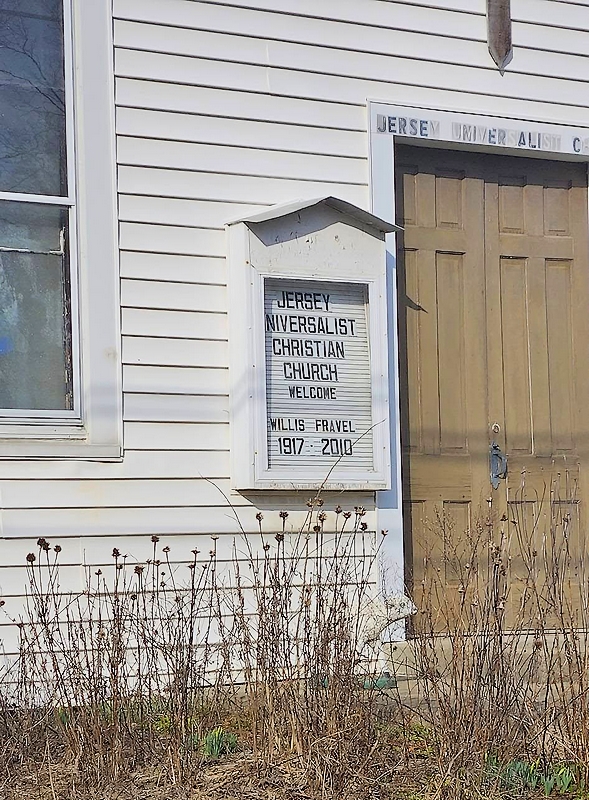
2024 | Scott Sloan
>
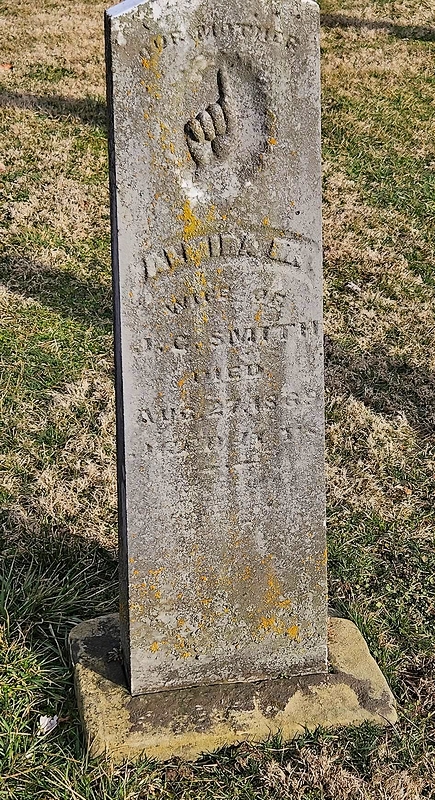
Cemetery Marker | Scott Sloan
Ministers Associated with the Jersey Universalist Church:
Brister writes in 1909,
"The Jersey parish is of a group of parishes that for forty years has done circuit work and for twenty years was under the pastoral charge of Rev. W. B. Woodbury, whose memory is treasured among them".6
As Brister gives us no clues about how date those years, we will just have to assume that for many years the Jersey church was part of a ministerial circuit. W. B. Woodbury was a Central Association Trustee and Clerk. Whether he administered the circuit or actually traveled circuit Robinson does not note, although did evidentially preach at Jersey for a few years.
We do however, know some of those who ministered at Jersey, some with dates, some not. Some of these are circuit riders and may perhaps overlap each other:
Rev. Curry (1824), Rev. Mr. Rogers (1825, 26), Rev. Truman Strong (1829 – 1833, 1837 -- ?), Rev. S. W. Henry Jolly7 (ca. 1833 – 1837), Rev. Mr. Eliphalet Case. Case (1842), T. C. Eaton in (1844 -- ?), Rev. Mr. N. B. Johnson (1846 -- ?), William Norton (1848), Henry Gifford (1849 -- ?), Samuel Binns (1854 -- ?), Rev. Woodrow, Rev. Manley, Rev. William W. (?) Norton, Rev. W. M (?) Jones, Rev, Ralph, Rev. W. B. Woodbury (ca. 1855 – 1857 ), Rev. Nathaniel Crary (ca 1858), Rev. F. M. Yates8 (ca. 1885), Rev. Nathan Rice. Quackenbush (ca. 1889), Rev. William Tucker D. D. (after. 1870), Rev. Frank M. Pitkin, (ca. 1896) Richardson, Eliphalet Case. White (ca 1906), A. M Stirton (ca. 1905), Rev. O. G. C'olegrove , of Plain City (ca. 1909), George F. Thomson (ca. 1905), and William Ezra Leavitt (ca. 1906).
The Beems, Merrills, Rhodes, Belknaps were apparently leading families within the Jersey Church.
Notes:
1. Brister, E.M.P. (1909) Centennial History of the City of Newark and Licking County Ohio, Vol. 1. (S. J. Clark) p. 473.
2. 1917 - 2010 are the dates for Willis Fravel, a lifelong member of the church, who passed away on October 17. His funeral services were held at the church a few days later.
3. ibid.
4. ibid.
5. The note that the sanctuary could seat around 300 people, calls into question the building in the picture, which is without doubt the Jersey Universalist Church. As Brister was living and acquainted with the church, it is unlikely that he would make a mistake. Is it possible that some time following both Brister and Robinson (1922) that something happened that necessitated the building of a new church? Perhaps 1917 as the signboard indicates?
6. Brister, op cited.
7. Previously a Circuit Rider, preaching mostly in homes. Jolly may have called on Jersey before 1824.
8. Methodist minister from West Virginia, licensed by the Ohio Universalist Convention to preach.
Bibliography:
Brister, E.M.P. (1909) Centennial History of the City of Newark and Licking County Ohio, Vol. 1. (S. J. Clark).
Robinson, Arnold Elmo (1923) The Universalist Church in Ohio (Ohio Universalist Convention).
OHGenWeb Archives Project, http://www.usgwarchives.net/oh/tombpics/licking/jerseytwp/jerseyunivcem/jerseyunivcem.htm
Image used with Permission]
[Updated: April 26, 2026 - Church history may be updated as new information comes to light.]