Christian Universalism

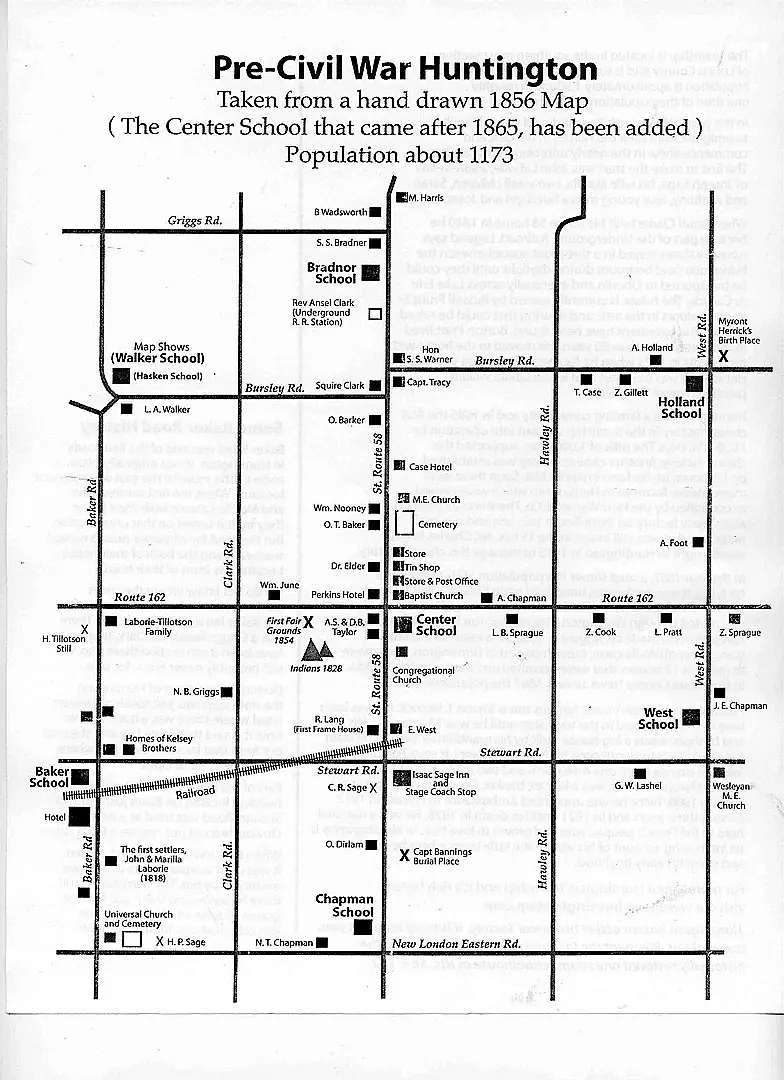
Huntington Township 1856 Map
Church & Cemetery Located Southwest Corner of Township
The United Christian Church
of Rochester and Huntington
Universalist Cemetery
Huntington, Ohio
[47802 New London Eastern Road (County Road 40).]
At best, historical information is sketchy, if any exists at all, when a church no longer exists. For Ohio, we have Elmo Arnold Robinson’s, The Universalist Church in Ohio which comes the early days up to 1921, but even with Robinson there are gaps and contradictions. Information is a bit more forthcoming with the town has recorded her history. But even these are incomplete, and often erroneous. Add to this the fact that there are two other “Huntington Townships” in Ohio, one of which may have had a Universalist church.
The United Christian Church of Rochester and Huntington is one of those churches. Besides a scant bit of history, the only evidence that it ever existed is the cemetery. I have tried to piece together the scant information that is available into a coherent, but brief, history.
Among the first settlers of what was to become Huntington was the family of John Sage, arriving in 1818. They, with other settlers arrived from Huntington, Connecticut. Although the Sage family played a prominent part in history of the Huntington church, it is not known whether John Sage was a Universalist. The first mention of a Sage is Brother Sage, who in late September, 1834 accompanied an itinerant Universalist minister visiting from New York to Huntington from New London.
It appears that those that held to the Universalist doctrine of ultimate reconciliation were informally meeting in both Huntington and nearby Rochester before this time as first attempt at organization occurred in 1834. The Universalists organized once again in 1846. (I have found no record of why this reorganization was necessary. In 1858 the congregation was fellowshipped by the Murray Association as the United Christian Church of Rochester and Huntington. In the 1870s the congregation who up until then had been meeting elsewhere (one correspondent said at the Baptist Church, another the Village Hall), decided to subscribe to the building of a church.
The church was plotted on farm land donated by H. P Sage (1), to the west of his home and the cemetery (est. 1833). The church was completed 1887, dedicating it in 1888.
By the turn of the century Huntington had at least four churches, a large number for a small community, and church attendance was declining in all four. In 1933 three of the churches – Universalist, Community and Methodist church – came together to form the United Church of Huntington (2).
Between the first organization and the 1933 merger, at least 18 ministers had served the church as “placed ministers.” Prior to the 1834 organization the Universalists, generally meeting in homes, were ministered to by visiting “evangelists,” and circuit riding pastors. Between 1908 and 1910 (?), Rev. Thomas Briggs served the Huntington, Olmsted, Leroy (Westfield Center) circuit.
The Murray Association Yearly Meeting met at Huntington in 1837, 47, 93, 1908, 12, 21. Over the years it appears that the church had a close relationship with the new Universalist College (Buchtel) in Akron. The esteemed Buchtel professor and minister, Ocar E. Olin, preached frequently at the church.
Two other pastors of note are the Rev. Daniel Tillotson and N. S. Sage. Tillotson, born in New York state in 1794 and was ordained as Baptist minister and migrated to Huron County to minister. In 1833, local folklore has it that Tillotson arrived in Huntington to pastor the newly established Baptist Church. Within three years he converted to Universalism, and was fellowshipped in 1836 by the Murray Association and served as minister. Although the dates are unclear, Tillotson served as pastor to the Huntington Church in the late 1830s. He lived in Huntington until he died in 1857.
N.S. Sage, was born in Huntington and educated at Oberlin College where he received his LL.D. He was fellowshipped around 1860, briefly served the Huntington Congregation before going on to become a Union chaplain during the Civil War.
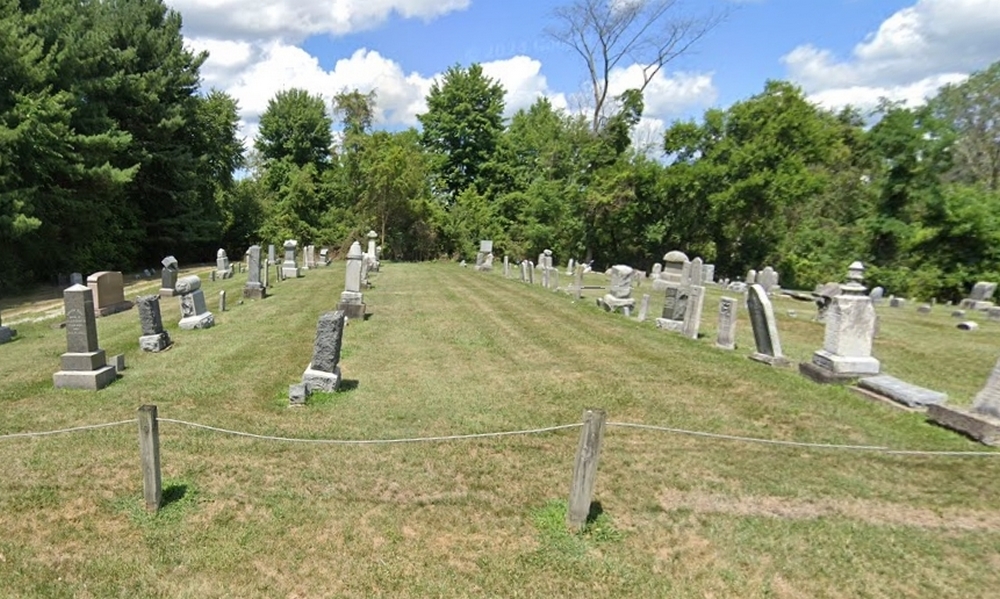
The cemetery dates to 1833, a year before the Huntington Universalist church was organized the for first time. It may have been first started as a family cemetery, and in time became known as the Universalist Cemetery. At some point in time (some accounts say in, or around, 1839) it was conveyed for a sum of 1 cent to the Huntington Township trustees. The cemetery is more often referred to as Evergreen Cemetery, although many older residents refer to it as the Sage or Universalist Cemetery. The readable headstones contain the names of a few Universalist ministers and several congregants, especially “Tillotson.”
Notes:
1. H.P Sage served as minister between 1840 and 1842, and again from 1846 to 1850.
2. Sometime in the early 2000s the United Church became a member of the Conservative Congregational Christian Conference, the most conservative branch of the Congregational Churches in America. The CCCC was formed in 1948 in reaction to the “liberal trends” of Christianity.
Bibliography:
Robinson, Elmo Arnold, 1923, The Universalist Church in Ohio. The Ohio Universalist Convention.
Huntington Township Historical Society
[Church history may be updated as new information comes to light.]