Broken
A Sermon | February 8, 2026
First Presbyterian Church
Sandusky, OH
 <
<Psalm 34:15-22, 2 Corinthians1:1-7, Mark 14:12-26
A few years back I wrote a couple prose pieces about Communion, both were titled, “The Table.” The first of the two pieces was a personal one, my experience. “I come to the table ….” The second was a corporate look at the Table, “We come to the table ….”
This morning as we come to the Communion Table I want us to think about the experience – the breaking of the bread, the drinking of the wine – both as a corporate community and as an individual act.
We begin with the corporate aspect of the Table.
The corporate aspect is good Presbyterian theology. In our Book of Order we are reminded that early Church gathered together, of one accord, to break bread. Our Book of Order instructs us that we are not to take of bread or the cup alone, but rather, always in the company of others. Traditionally, we wait until all have been served and then partake together.
Let’s look at the corporate nature of both the First Supper and those of the early church.
We begin by asking, what was the corporate nature of that First Supper?
We know that it was a simple one, a meal that consisted of Jesus and his disciples.
That included …
Judas, whose spirit was already broken enough that he felt he needed to betray Jesus.
Peter, who in just a few hours was to deny Jesus three times, although vehemently denied that he would.
Thomas, who would doubt his resurrection.
The rest who quickly scattered at his arrest.
Broken people.
What makes the Lord’s Supper amazing is that Jesus exactly who was going to do what, sat down with them all and broke bread. He didn’t scold Peter. He didn’t chastise Judas. He rebuked not one of the disciples.
To Jesus, they didn’t cease to be disciples. To Jesus, they didn’t cease to be a company – a community – of disciples. The company of disciples was broken, but that didn’t matter.
What mattered was that the company – in spite of being broken – was one body…
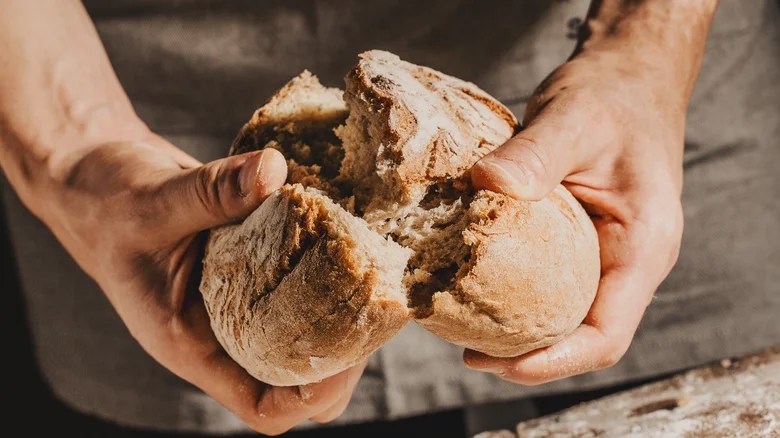
He took the bread and broke it, saying “this is my body, broken for you.” “YOU” and interesting word in both English and Greek …
“YOU” can be both plural and singular. “This is my body broken for all of you, who are one body.” “This is my body, broken for each of you.”
Incidentally, for us Christians, that “one body” is the Church. The spiritual body of Christ.
“My body, broken for you.”
Broken, an interesting word. Broken like a stick? No. We are told that not one bone in Jesus’ body was broken. So, “broken” how?
In Greek, the word means “to extract.”
We tend to skip from the Last Supper to the crucifixion. And in doing so, we skip over Jesus’ anguish in the garden:
In both the Gospels of Matthew and Mark he says, “My soul is overwhelmed with sorrow to the point of death (Matt. 26: 38, Mark 14:33).” In Mark though, Mark prefaces these words of Jesus with, “He [Jesus] began to be deeply distressed and troubled.”
It is in the garden that Jesus became broken – that his spirit was extracted.
During the Last Supper Jesus instructed the disciples to remember each time that they broke bread that not only was he broken for them, but they too were broken. The company of disciples was broken, and in that corporate brokenness they each were broken.
At the time of the Supper they didn’t understand. It wasn’t until after Jusus’ death and resurrection that they began to wonder about the words.
What would you be thinking if you were that early company – that first body of post-resurrection Jesus followers? Certainly confusion, perhaps mingled with a bit of wonderment. Maybe even some disbelief. After all, they only had the word of a few who claimed to see Jesus.
What unified them was the act of Communion. They came together to break bread as one.
(They didn’t) We don’t come to the table to fight or to defend.
(They didn’t) We don’t come to prove or to conquer,
To draw lines in the sand or to stir up trouble.
We come to the Table
Our hunger brings us there.
We come needy.
With fragility,
With an admission of our humanity.
The Table—
The great equalizer,
The level playing field.
The Table—
The place where the doing ends,
The trying stops,
The masques are removed.
The Table—
Where like children
We allow ourselves to be nourished,
We allow Someone else to meet our need.
The Table—
In a world that takes pride in not having needs,
On going longer and faster,
On going without,
On powering through
The Table—
A place of safety
Of rest
Of humanity
The Table—
Where we are allowed to be
As fragile as we are.

With the corporate body, the “we” becomes “I.” We are as a body of believers, the Church. We are as the Church individual believers, each with our own brokenness.
So, the question each of us must ask of ourselves, is why do I come to the Table?
Let’s go back to that first Supper ….
The disciples were there because Jesus said, “Let’s sit for a meal.” They really had no idea why they were there, other than they were having a meal.
It wasn’t until after the meal, that Judas betrayed Jesus, that James and John (along with Peter) weren’t able to be along side of Jesus in his anguish, that Peter denied knowing Jesus or that Thomas doubted his resurrection.
John in his Gospel tells us the disciples after the resurrection. They’re in a locked room. Fearful of the Jewish authorities. While they were, I am pretty sure, sharing some bread and wine, huddled together, Jesus appears in the room. At that moment, I believe each disciple knew that they were loved by Jesus and by God. The scripture says that they were “overjoyed.” “Overjoyed.” They didn’t have to make themselves worthy of God’s love, it just was. They were alright WITH God.
I think we often miss this when we celebrate Communion. We don’t come to the Table to have God make us worthy; we come to the Table because in God’s sight we are worthy. Always have been.
I came to the Table,
I fell to my knees,
I cried, “God forgive me!
Make me worthy to eat the bread,
Drink the wine.”
I came to the Table
To get right with God,
Instead,
God said,
”You are alright with me.”
I had it backwards.
Coming to the table
is not about
My getting right
With God.
I come to the Table,
Because
To God,
I am
All right.
Did not Jesus
Share his Last Meal
Without Judgment…
With Peter
Who shortly denied him?
With Judas
Who shortly betrayed him?
With disciples
Who ran for the hills?
This my body broken for you.
This is my blood poured out for you.
But do we think about them?
Amen