Christian Universalism

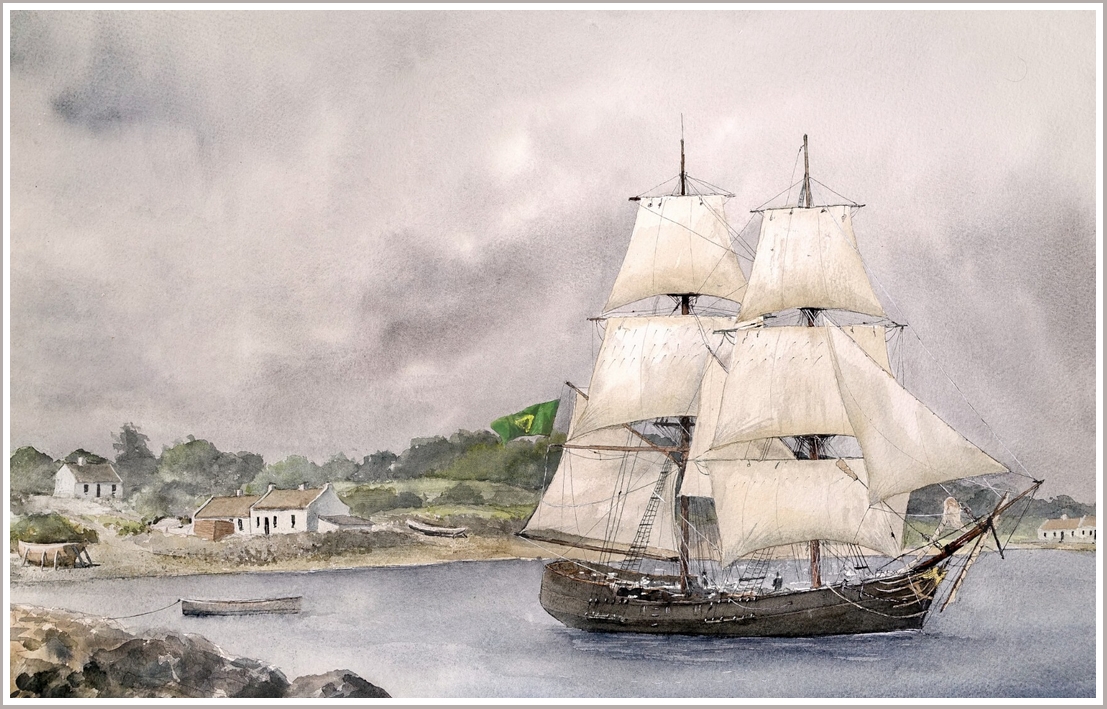
Eagle Wing
Painted by Dan Parsons
The Story of the Eagle Wing
An American Universalism That Might Have Been
If it weren’t for a death, a storm and a ship wreck, Christian universalism would have arrived on America’s shores before John Murray migrated from England in 1770. And believe it or not, it would have been Presbyterian.
On September 9, 1636, only twelve years after the first Mayflower landing, a small 150-ton ship, the Eagle Wing set sail for America.1
But the story really begins some thirteen years earlier with the surrender of Hugh O’Neill and the Gaelic army to the forces of Elizabeth I, the last Tudor monarch, in early March, just a week or so before the Queen died. With the succession of James, I Ulster saw the establishment of the Plantation scheme. The first, beginning in 1606, were private. In 1611 public plantations were instituted. Thousands of Scots who in their homeland were being pressured to subscribe to the State church, migrated to Ulster. Among this number were the Non-Subscribing Presbyterians, who refused to subscribe to any Confession. Unfortunately, there was not enough land in Ulster for the arriving immigrants, even with driving out the Gaels from their homeland.2 By 1626 Scots-Irish Presbyterian clergy, who ironically had been placed in Anglican Church of England parishes were coming under pressure to subscribe to the creeds. How that came to be is a story for an essay on the Non-subscribing Presbyterian Church of Ireland.
As the pressure mounted, many Scots-Irish Presbyterians began looking to America as a possible home. It should be noted, that many of Scots-Irish Presbyterians being non-credal were Universalists, or at least sympathetic to the idea.
The Massachusetts Bay Company was formed in 1629 under John Winthrop. The Scots-Presbyterian (non-subscribing) minister, John Livingston was appointed to travel to Massachusetts to seek a grant of land for the Ulster dissenters. His voyage became unsuccessful when storms and illness forced his ship to return home. Livingston then sent a enquiry to the colony. In the fall of 1634, the Governor’s son arrived in Ulster to discuss the possibility of a Presbyterian emigration. Subsequently, Winthrop “did earnestly invite and greatly encourage us to prosecute our intended voyage (diary of The Rev. Robert Blair).” This encouragement also consisted of a grant of land for settlement.
Subsequently, a meeting of those interested3 took place at the home of the High Sheriff of Antrim, Sir John Clotworthy, a staunch defender of the Presbyterians. At this meeting plans were made to build a ship for the crossing. In 1636, the ship was ready and christened, The Eagle Wing, after Exodus 19:4 (“You yourselves have seen what I did to Egypt, and how I carried you on eagles’ wings and brought you to myself”).
The pilgrimage was scheduled for the late May of 1636, when there was more chance of calm seas. However, before it had a chance to sail, Sir Hugh Montgomery, the patron of the Ulster Presbyterians died (May 15). The four ministers who had been commissioned to sail with the Pilgrims each had personal connections though marriage and appointment to Sir Hugh (3). Not wanting to set sail before the funeral, which didn’t take place until September 8, the sailing date was delayed. Finally, on September 9, 1636, the Eagle Wing set sail from Groomsport, Co Down with about 140 passengers aboard—men, women & children4.
Not long after leaving Ireland, the ship met contrary winds and had to take shelter in Loch Ryan. After the winds became favorable the Eagle Wing entered the Atlantic and once again set sail for the New World—only to encounter more trouble. Fierce winds, high waves and torrential rain plummeted the ship. Livingston records: “Heavy rain did break our rudder, much of our gallon-head and fore-cross-trees, tore our foresail, five or six of our champlets and a great beam under the gunner-room door broke. Seas came in and wet all them that were between decks.” Rev Blair, the acknowledged leader of the group writes in his dairy: ‘When we had passed the back of Ireland and had entered the great ocean, O what mountains, not waves of sea did we meet. The swellings of the sea did rise higher than any mountains we had seen on earth, so that in the mid-day they hid the sun from our sight.” Thanks to the bravery of a sailor who is lowered into the water, the rudder is fixed. Nevertheless, by this time the ministers are questioning the wisdom of traveling on. It seems to them that even though they are closer to America than Ireland divine providence would have them return to Ireland.
Rev. John Livingston writes, “(But) if ever the Lord spoke His winds and dispensation, it was made evident to us that it was not His will that we should go to New England.” The Eagle Wing limped back to Ireland, arriving in Lough Fergus on the third of November, a little over two months after they set sail. Somewhere along the way, the Captain of the Eagle Wing was removed. Perhaps because he didn’t want to turn back, rather continue on to New England which was closer?
In spite of storm and the hardships of life aboard, only one elderly person and one child died and were buried at sea. A baby, appropriately named “Seaborne” was born during the voyage. He was baptized the Sunday after by Rev. Livingston.
Upon return home, some vowed to try again, but most remained convinced that God wanted then to work for religious freedom in Ireland. Something that was not to be realized until December 15, 1971, and then only sparingly if you were Roman Catholic.
The ministers preached among their flock, but always aware of the anti-non-subscribing Presbyterian sentiment. A few years after their return, warned of imminent arrest, they returned to Scotland to preach.
Although the Eagle Wing was the first attempt of the Scots-Irish to emigrate, it was not the last. Over the 18th century over 400,000 people emigrated to America from Ulster. Many of these were Universalist non-subscribing Presbyterians. Perhaps we will never know how they laid the groundwork for Murray and the Christian Universalist Church.
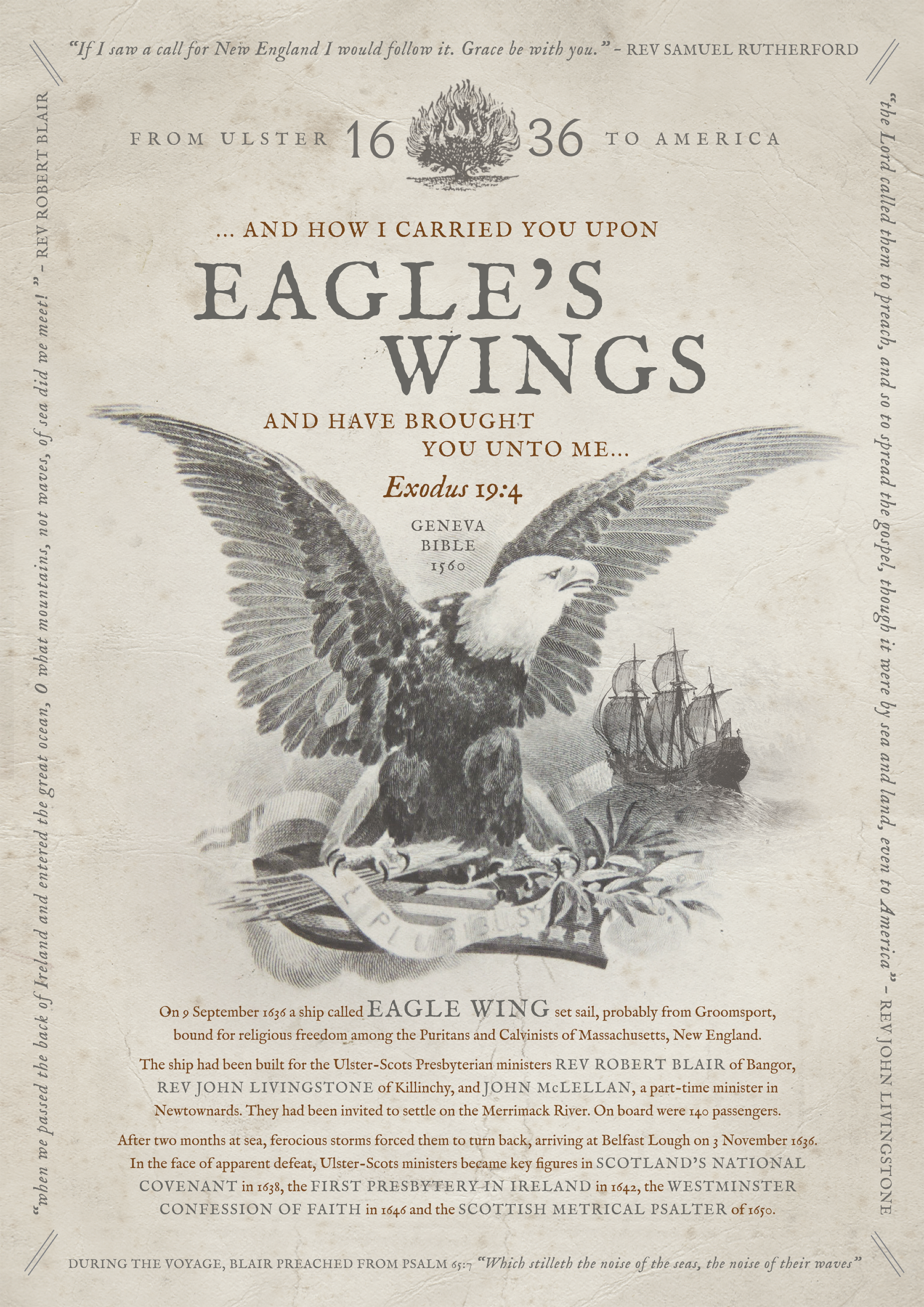
Anniversary Celebration Poster

Notes:
1. Some accounts say “Eagle Wings.” Other call it “Eagle’s Wing” or “Eagle’s Wings.” This latter is how a museum display names the ship. Clearly from records the name of the ship was “Eagle Wing.”
2. This became the root cause of the conflict between Northern Ireland and Ireland.
3. Rev Robert Blair (Bangor-H), Rev John McClelland (Newtownards-M), Rev John Livingstone (Killinchy-H), Rev James Hamilton (Ballywalter -Hamilton’s namesake and nephew) McClelland’s brother was married to another of Montgomery’s daughters.
4. There is some doubt as to whether the ship was built in Groomsport. Adair in his autobiography just states that a ship was built near Belfast. Although Groomsport is not all that far from Belfast by today’s standards, in the 1630s with travel limited to wagon, horse or boat, it would have seemed a further distance. Another possibility would be Carrickfergus. The ship certainly left from Lough Fergus (Now Belfast Lough).
John Anderson wrote the musical “On Eagles Wing” based on this voyage and similar ones over the years. It was released as a film in 2005.
Eagle Wing Image: Dan Parsons [External Link]
Information Source: Presbyterian History Society of Ireland [External Link]
A Bit of Background
In Scotland, Presbyterians were under persecution by the Anglicans and displaced to Ireland where they were employed within the poor Irish Episcopal Church (Church of Ireland). A unique experiment, Presbyterian ministers working in Anglican parishes. The earliest known of these ministers was the Rev. Edward Brice who officiated at Broasisland (Ballycarry) from 1613.
The Presbyterian ministers were involved in a religious revival that originated in Oldstone, near Antrim, in 1625 and sweep across the Ulster plantations. The Anglican Church and the government pressured the Presbyterians to conform and subscribe to the Westminster Confession. In 1631, suspensions were enacted against non-conforming ministers, briefly lifted, then renewed in May 1632. Yet the minsters refused to subscribe.
Finally, the government had enough and on August 12, 1636, the five leading ministers, including Brice, were permanently removed from their parishes. Fearing that they would never be free to believe as they wished they began to seriously develop a plan to emigrate to the New World.
[Story may be updated as new information comes to light.]