Christian Universalism

The Swedenborgians & Universalism
New Church
The New Church (Swedenborgian) was the spiritual home of Johnny Appleseed, a Swedenborgian missionary who sowed apple seeds as he preached the Gospel. But this entry is about Swedenborgian universalism.
Swedenborgianism is a somewhat complex theological construct that Emanuel Swedenborg (1688–1772) introduced through his writing. However, it was not formally organized as a church until 1787, in England. The church is formally known as the "New Church." Swedenborgianism has a universalistic bent rooted in the belief that God desires the salvation of all, and is a lovely universal presence. Swedenborg believed that hell is a real, self-created state. Yet his writings indicate a universal hope for salvation for all through spiritual growth and God's permeating universal love. He suggests that God reaches down into our self-created hell (perhaps even into an after-life hell), seeking to lift us out. If we were to use moden nomenclature, perhaps we would say that Emanuel Swedenborg was a "hopeful universalist."
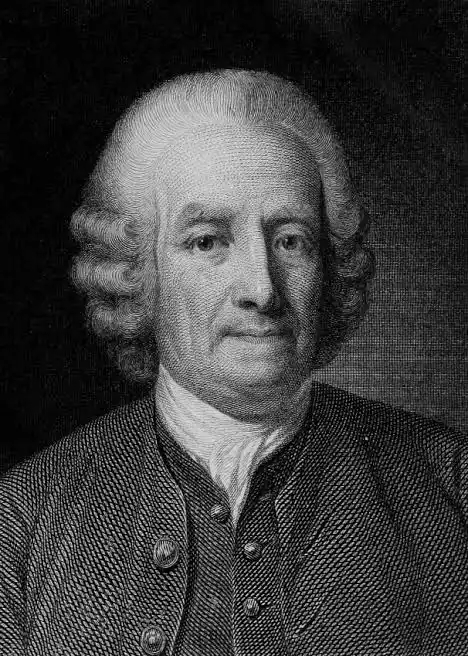
Emanuel Swedenborg
The complexity of Swedenborg's thinking seems to present both pro and con reasoning for universalsim:
Pro:
(1) Focus on love and charity: Swedenborgians believe that living a life of love for God and neighbor is the ultimate path to salvation, and this path is open to everyone regardless of their religious background.
(2) God's providence: Emanuel Swedenborg taught that God's providence aims to develop everyone into more loving beings, a process that can continue after death (see 3).
(3) The "Universal Human" concept: The idea of a "Universal Human" suggests that all of creation is part of a single, interconnected spiritual body, sort of a web, which is a (the?) manifestation of God.
(4) Afterlife instruction: Those who died without knowing the "correct" faith are given the opportunity to be instructed in the afterlife.
Con:
(1) The reality of hell: Although a self-created state, Swedenborg also described hell as a real state (place) resulting from a person's self-centeredness and conscious rejection of good.
(2) Eternal separation: Some passages suggest that it is difficult, if not impossible, to escape hell once a person has fully chosen a life of evil and self-love.
(4) Free will: The Swedenborgian emphasis on free will means that individuals ultimately choose their own eternal path, and for some, this is a choice that leads to hell.
Note: The difficulty we have with Swedenborg is that it is hard to distinguish when he writes about hell whether he is talking about a psychological or physical place, or even both simultaneously. The moment we think we understand his "hell," he writes something that causes us to shake our head and start all over again. Today, a goodly portion of Swedenborgian believe in at least the possibility of ultimate harmony with God.
More information can be found in the New Church website. [External Link]
[Blurb may be updated as new information comes to light.]