Christian Universalism

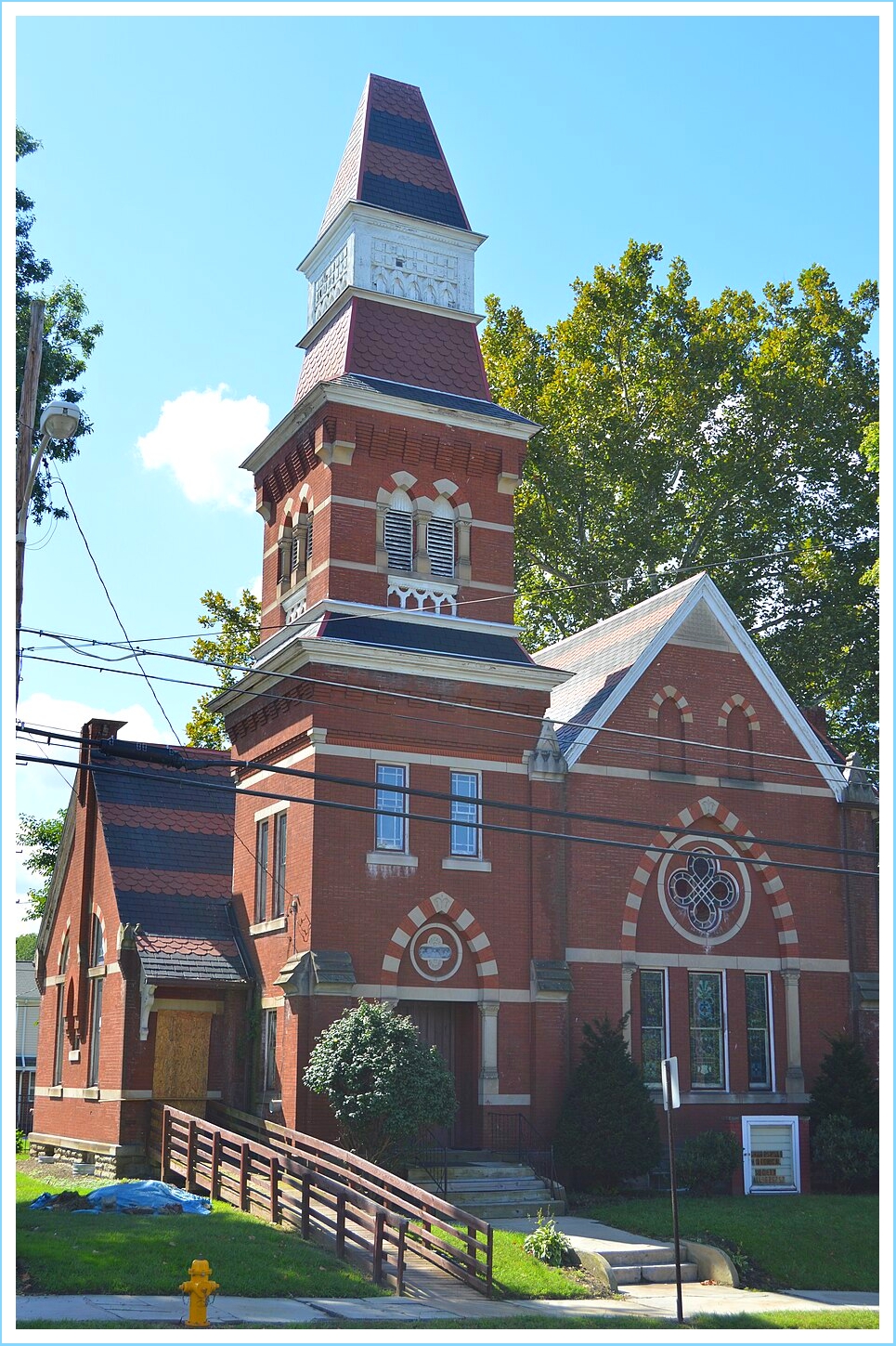
2026 Image
First Universalist Church
Church of Our Father1
Sharpsville, Pennsylvania
1874-1923
Church Built: 1882-1884 | Dedicated: Feb. 10, 1884
Currently: Chloe Memorial Chapel & Museum (Sharpsville Area Historical Society)
131 N. Mercer Ave.
Note: When I begin researching the story of a particular Universalist Church, I never know where that research will lead me. Often to dead ends, but more often, to surprising and unexpected discoveries. Researching the story of the First Universalist Church of Sharpsville, PA took me on a journey to a nascent Universalist School in Akron, OH. It led me through several generations of the Pierce family to Barbara Bush, and along the way, canal boats, iron foundries, an organ (with its own story) and even a Baptist church appeared.
Ultimately, the story of First Universalist is the story of dreams and industry—and love.
The story begins not in Pennsylvania, but in New Hampshire with a Universalist who dreams of a new and prosperous life in the wilderness of northwestern Pennsylvania—James L. Pierce.2 I will interrupt the story here to note, that if there was no James L. Pierce, there would be no First Universalist Church in Sharpsville, or at least as we know it today. And in many ways, the same could be said of almost all Universalist churches, they happened because someone dreamed of a local Universalist Society.
Still, the story of First Universalist seems more personal than most.
Moving along, we follow James L. and Chloe Pierce first to Erie County in 1847 where he becomes involved in the transport of coal via canal boat. As business expands Pierce moves first to Clarksville (now Clark) to further his coal business. By now he is a well-to-do industrialist businessman involved in the transport of coal and the import of iron ore. Sensing opportunity the family moves to Sharpsville in 1860 where Pierce takes the next natural step, the manufacturing of pig iron.
When the Pierces arrived, Sharpsville was nothing more than a tiny hamlet with ten or so homes, a grist mill, a saw mill and a canal lock. By the time of his accidental death in 1874, Sharpsville had become one of the nation’s leading producers of iron, principally due to his enterprise. Pierce, and later his sons (Jonas J., twins Walter and Wallace, Frank, and James B.). owned seven on the town’s nine blast furnaces, as well as the Sharpsville bank, newspaper and railroad. Due his efforts the town folk added the prefix, “General” to honor his contribution to the town.
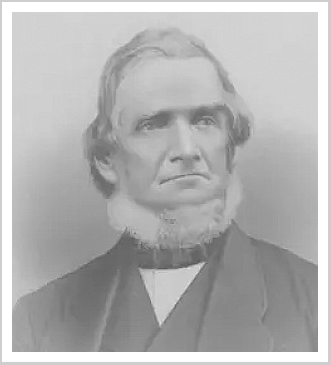
James L. Pierce
It is this wealth that built the church, but I am getting ahead of the story.
Although we do not know little about how the Pierces practiced their Universalism in Erie or Clarksville, we can assume that they practiced their faith as they could. During their time in Erie County, the Pierces became acquainted with a few Universalist ministers. As Pierce desired to see a Christian Universalist Society take hold, shortly after their arrival he began inviting them to preach on occasion in Sharpsville.
The first of these ministers was the Rev. B. F Hitchcock of Conneautville, PA., and later, Rev. C. L. Shipman. In time through the efforts of these ministers and the godly influence of Pierce there were enough Universalist to form a society. Sadly, Pierce died on December 2, 18743 from a tragic accident two months before the Society was organized on January 31, 1875 with 28 members, including the Pierce family and other town notables. The formal organization undoubtedly delayed by the death. Rev. Shipman, who had been contracted in 1873 to preach every other week, served as the organizing minister and continued to do so until 1884.
Throughout the history of Universalism there have been many influential and devout Universalist who have slipped through the cracks of Universalist history. James L. Pierce is one of those whose story needs to be researched and told. Pertinent to the Sharpsville Church is both his and Chloe’s connection with the nascent Universalist college in Akron, OH, Buchtel College.4
Before we move on, it should be noted, that in keeping with his universalist faith that endows a benevolence toward all, Pierce contributed land and finances for the building of the town’s Baptist Church (even before his dream of a Universalist Society was fulfilled), as well as to other local endeavors. He built, what is now known as the “Pierce Block” for his bank and offices, yet included a large opera hall as part of the block. It was in the opera hall that the Society met until they were able to build a church.
As a successful industrialist it was only natural that Pierce would become acquainted with the Universalist industrialist in Akron, 64 miles away, who came together to found Buchtel College in 1870—John R. Buchtel, John F. Seiberling, and the cereal magnate, Ferdinand Schumacher.
Pierce, who contributed significantly to the college, became one of the first trustees of the college, establishing a long connection between the Pierce family and Buchtel College, and the college and the church. In 1873 Pierce made a gift of $10,000 in honor of his wife, Chloe, to endow the establishment of the Chloe Pierce Professorship of Rhetoric and English Literature. In 1874 Chloe Pierce made a gift to establish a chair in honor of her husband. Today both legacies continue as the “Pierce Professorship.” Although accounts contradict, one of these two gifts established a female professorship. Between 1873 and 1887 Susannah “Susie” Chamberlain (later Cole) taught English and Rhetoric at the college, making it likely that it was James’ gift that established the female professorship.5 The Pierces also endowed at least one perpetual scholarship in 1873. It appears that the sons continued to support the college.
We now come back to the church:
Under the leadership and preaching of Rev. Shipman the Society continued to grow, and in 1881 a building committee was established and Samuel W. Foulk6 was commissioned to design the edifice. Foulk designed a High-Victorian Eclectic building [see “Architecture” following] befitting the status of the founding family. On October 10, 1882 the cornerstone was laid. Rev. Dr. Orello Cone,7 the President of Buchtel College and a friend of the family, preached the dedication sermon. Before his untimely death Pierce had apparently already made land available for the building of the church when the time came.
Rev. Shipman preached irregularly through January 20, 1884. His successor was W. A, Pratt who preached the first sermon in the new sanctuary a week later.
The church was completed by the beginning of 1884, and dedicated on February 10, 1884 (with Dr. Cone again preaching) at a cost of $16,000, much of which was funded by Chloe Pierce as a memorial to her late husband.
The clerk’s records note: “As the pastor finished the sentence of dedication with these words, ‘Henceforth this church stands devoted to the unchanging love of the father of all spirits,’ the sun, which for more than a week had hardly pierced with its rays the thick black clouds which had obscured the sky, shone forth with noonday splendor, filling the whole auditorium with light. The circumstance to many was very impressive.”8
The Pierce family remained active in the church for as long as there was a Universalist Church. The sons for over thirty years contributed to the church’s finances and served as lay leaders and trustees. The brothers contributed $4,000 to build a magnificent parsonage in honor of their mother. The parsonage was completed in 1888.
Coinciding with the dedication of the church was the dedication of an Opus 227 organ. The organ was donated by Chloe Pierce in honor of her sister, Abida Boles.
The Society continued until about 1923 when services ceased. In 1927 the church served as a temporary home to a Presbyterian Congregation and a USO hall during World War II. Otherwise, the church sat mostly unused until in 1945 the Universalist Conference sold the church to the Seventh Day Adventist. It is a somewhat of a miracle that during this the church remained in relatively good condition and unchanged. Something that does not often happen to a vacant church or one occupied by another denomination.
In 2000, the Sharpsville Area Historical Society realized that “if someone didn’t take the church then the organ and the stained-glass windows would have all been scrapped.”9 Thanks to the Society’s diligence, the church is being lovingly attended to. Unfortunately, the neighboring parsonage has not fared as well. It sits greatly altered and boarded up. Today the church is known as the Chloe Memorial Chapel. The church was added to the National Register of Historic Places on May 29, 2003.10
In 1982, Barbara Bush while on the campaign trail for her husband, George H. Bush, visited Sharpsville for the 100th anniversary of the church. Jonas J. Pierce, the son of James, is her great-great grandfather.11
Architecture
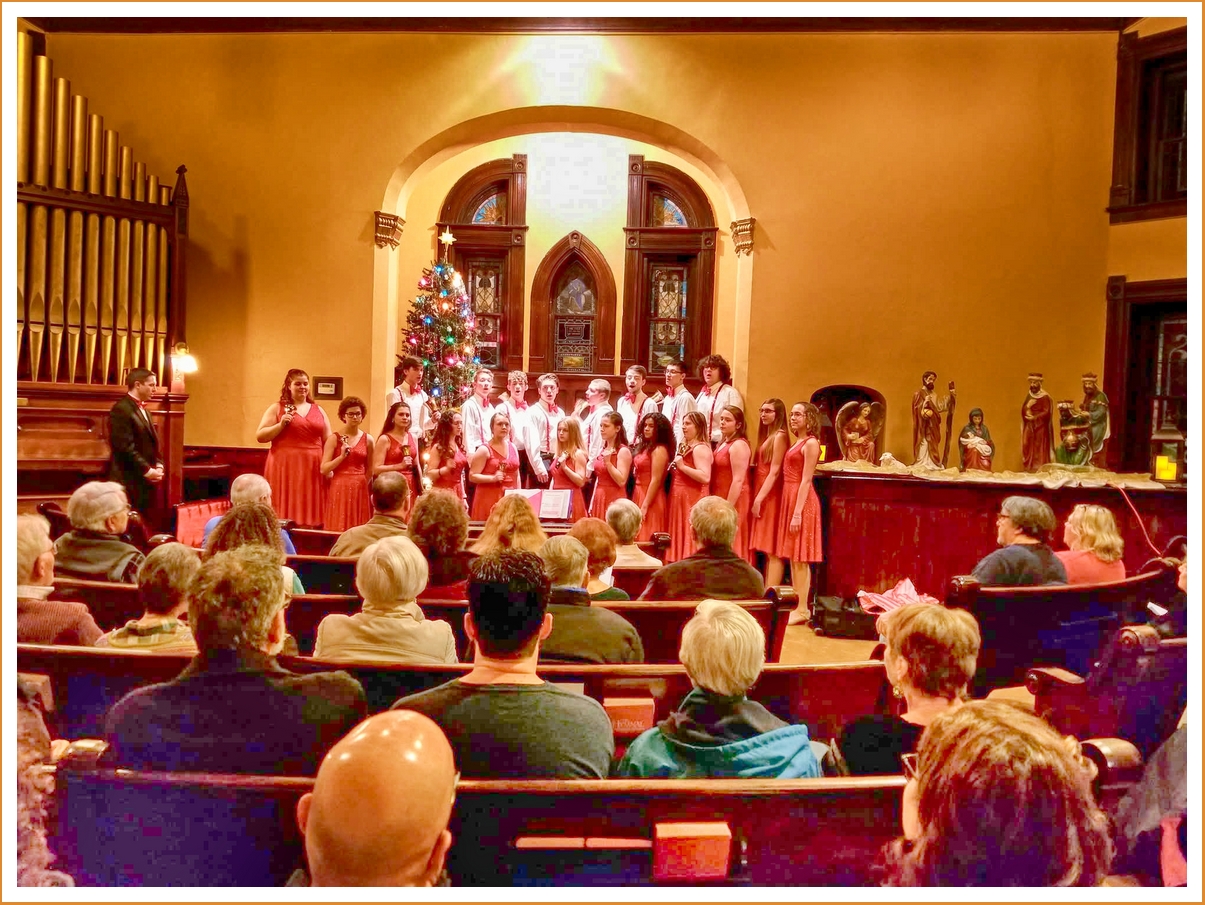
Interior
Among local Mercer County churches, First Universalist is the most fully developed example of High Victorian Eclectic (Gothic). The interior follows the Akron Plan.12
The church is constructed of red pressed brick with a contrasting Amherst bluestone trim quarried in Amherst, OH (the quarries are only a few miles from where I live). The building rests upon a rusticated sandstone foundation.
Overall, the church features 30 stained glass windows. Most composed of hammered, rolled, opalescent, ruby flashed glass. The quatrefoil panes with patterns ranging from simple geometric shapes to complex floral and Christian motifs. The interior layout follows the Akron Plan and features lavish red oak wainscoting, doorways, and trim with black oak and cherry accents. Following the Akron Plan folding doors join a single Sunday school room to the sanctuary.
Among local churches of the 19th century, the First Universalist’s High -Victorian Eclectic architecture is the most fully developed expression of this architectural style. It is characterized by an “eclectic liveliness in its decoration. Seen here in polychrome contrasts, brickwork and stonework, and roof cresting. Keeping to the style the church features a steeply-pitched hipped roof and an auditor-style sanctuary based on the Akon Plan. Folding doors joining a single Sunday School room to the sanctuary.
Even the interior decorations featuring lavish red oak wainscoting, doorways and trim with black oak and cheery accents fit the style, as does the organ’s red oak casing. Likewise, the church’s 30 stained-glass windows. Most composed of hammered, rolled, opalescent, ruby flashed glass. The quatrefoil panes with patterns ranging from simple geometric shapes to complex floral and Christian motifs.
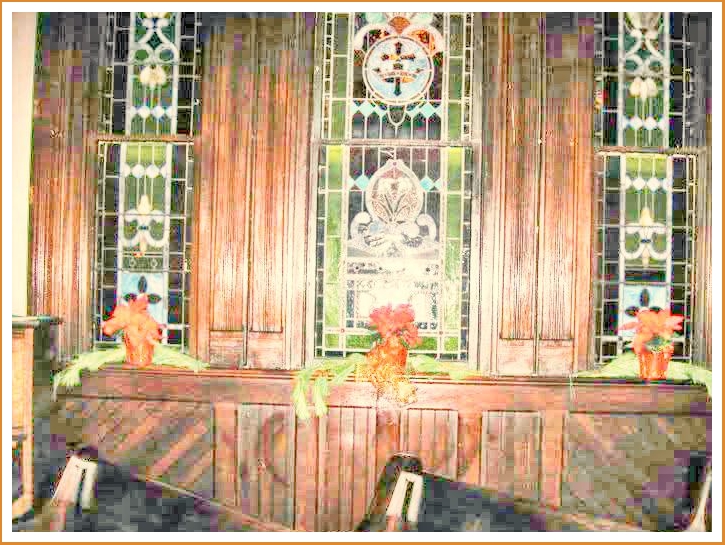
Stained Glass Windows
The church’s pipe organ, the first in Mercer County was built by the Pomplitz Company of Baltimore as Opus 227,13 and is original to the church. It has red oak casing which blends with the sanctuary woodwork. The organ retains her original stoplist and tracker and was restored in 2018.
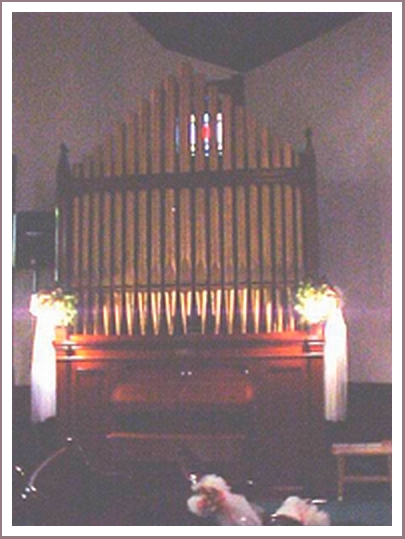
Pomplitz Opus 227 Organ

Known Ministers
C. L. Shipman, 1876; Samuel Hough, 1877; W. A. Pratt, 1884; DeWitt Lamphere, 1885; W. S. Williams, 1887; W. M. Backus, 1889; James Gorton, 1892; L. J. Richards, 1900; C. J. Harris, 1905 – 1909.14
Organizing Members
Hon. Nathan Morford, Aaron Fell, Jonas J. Pierce, Mahlon Fell, Andrew Fell, T. M. Ford, Henry Phelps, S. W. Johnston, R. J. McDowell, Seth Hofius, Alex. LaMont, Walter Pierce, J. W. Fuller, Frank Pierce, J. L. Weaver, Charles Wilson, Jesse Fell, I. N. Lynch, A. C. Andrews, T. O. Hazen, Mrs. Kate (J. J.) Pierce, Mrs. Mary A. Mortord, Mrs. Emeline Fell, Mrs. Susan Phelps, Mrs. Chloe Pierce, Mrs. Ursula J. Fuller, Mrs. Sarah M. Meecham. Mrs. Julia Ann Fell.15
Notes
1. “The Church of Our Father” does not appear in any official records, but according to T. M. Ford, a former clerk of the church it was the name given to the church by locals. (Twentieth Century History of Mercer County, 1909, pages 283-285.)
2. One of Pierce’s five sons was named James B. Pierce. “Pierce” when used without an initial refers to the father, James L.
3. Pierce was visiting his yet unoccupied newly-built mansion and accidentally tripped going down the cellar steps. He succumbed to complications resulting from surgery a week later.
4. Buchtel College was founded by the Ohio Universalist Convention in 1870. It is now the University of Akron, a state university.
5. University of Akron Archives. There is undoubtedly more about the Pierce family buried in the archives waiting to be discovered.
6. Sidney W. Foulk (1848-1932). He developed an architectural practice that specialized in schools, churches, and YMCA facilities and reached into several states. He generally favored a robust Romanesque Revival style, although not in the case of Sharpsville. Many of his churches utilized the Akron Plan for the interior arrangement.
7. Rev. Dr. Orello Cone (1835-1905). Russell E. Miller writes in The Larger Hope: The First Century of the Universalist Church in America, 1770-1870 the “greatest denominational contributions to religious scholarship in the late nineteenth century were my Orello Cone in the field of Biblical criticism.” To have Cone preach at both the laying of the cornerstone and the dedication of the church speaks both to the friendship between Cone and Pierce and Pierce’s dedication to Universalism.
8. T. M Ford, clerk’s records.
9. Ralph Mehler, Sharpsville Area Historical Society, treasure. Responsible for getting the church listed in the National Registry of Historic Places.
10. The National Registry Application contains an extensive architectural description of the building.
11. Barbara Bush’s ties to the church come in a direct line from James L. Pierce. Jonas L, the son of James L., is her great, great grandfather. Pierce family histories note that eight generations of the Pierces were devout Universalists, including Marvin Pierce (Publisher of McCalls and Redbook), Barbara Bush’s father. Her mother was a Presbyterian and although Barbara attended with her mother, she retained her Universalist leanings. (Salt Lake Tribune, 04.20.2018 “Barbara Bush’s old-fashioned religion.”)
12. The Akron Plan was conceived in mid 1860s by Lewis Miller, a philanthropist and inventor, working in collaboration with architect Jacob Snyder. The first church built to the Akron Plan was the First Methodist Episcopal Church in Akron, Ohio, which was built between 1866 and 1872. The plan takes its name from the city where it was first used.
The philosophy behind the Akron Plan was to break down the distance and “symbolic barriers” between clergy and the laity, while improving acoustics.The plan church may best be described as a “combination church” where the Sunday school were set around the sanctuary. The advantage of this was that the Sunday School Superintendent or Preacher could present a lesson to the assembled group, after which the students would discuss the lesson. Each room was shut off from the sanctuary by sliding/folding doors or curtains. In some larger churches there was also a similar balcony circling three sides of the sanctuary. A variant was where the classrooms were placed to the rear of the pulpit, facing the sanctuary.
The First Universalist Church of Sharpsville stands as an important example of the Akron plan’s development because it is one of the few currently documented examples of the Akron plan built before 1885.12a
Moreover, the compelling influence of the Combination Church, even during this early period of the Akron plan’s development, is shown by the Sharpsville church’s adaptation of the design typically employed in much larger churches with graded Sunday school classrooms.
The Akron plan found at Sharpsville—joining a single Sunday school room to the sanctuary—adapted the plan to a small church that would rarely have sufficient students to fill graded classrooms. Nonetheless, the essential feature of the Akon plan was obtained by separating the sanctuary from the Sunday School room with folding doors.
12a. The specific relationship between the Akron Plan and the Sharpsville are from the Registry application.
13. Chloe Pierce made at least one trip to Baltimore in 1882 to purchase furniture. As Baltimore was the closest large city, it is likely she made several both before and after In 1882, during the visit to Baltimore it is surmised that she visited the Pomplitz Organ Company and arranged for the church’s organ.
The daughter of the August Pomplitz, co-owner of the Pcomplitz organ company, Albertina P. Pomplitz, married James B., the son of James L. Pierce on June 20, 1879. No one today seems to know how they met. Albertina’s sister, Cecelia “Cissy” Pomplitz (referred to locally as “Aunt Cissy” lived with the Pierce family and were the last to live in the Pierce Mansion. Albertina was “a gifted pianist, a graduate of the Peabody Institute at Baltimore, and a lifelong member of the Episcopal church. Both however, contributed to, and were active in, First Universalist Church. The Historical Society President notes, “We’re still not exactly sure how the two ended up marrying, since she was not only from Baltimore but her family would have been considered middle class, whereas the Pierce family would have been more upper class.”
14. Clarence J. Harris (1873-1941 ). Over the years Harris ministered in both Universalist and Unitarian Churches. While in Atlanta, teaching at the Atlanta Congregational Seminary, in 1902 he converted to Universalism. In Atlanta he had condemned the city and the local churches’ lack of care for the poor. When he moved to the Universalist Church in Sharpsville, he became even more liberal in his Christian thinking. He wrote in 1908, that during his three years of preaching in Sharpsville he had “never preached anything save the most liberal thought.” His sermons ranged from “freethought” to “Socialism.” While in Sharpsville he published The Liberal Pulpit, a collection of sermons. A reviewer noted that it was “radically liberal for a church paper and well-worth reading by non-church Liberals.”
Once when commenting on the difficulty of attaching Free-Thinkers to the church, Harris noted that he had an undeserved reputation for being an infidel and a Jesus-denier. At a May 1908 Billy Sunday revival in nearby Sharon, he was held up for ridicule with the evangelist declaring that his “entrance into hell (will be) by an elevator.” In spite the ridicule Harris evidentially enjoyed the support of his church as the church trustees were listed as the publishers of The Liberal Pulpit.
Please read his biography (https://www.uudb.org/harris-clarence-j/). Harris was so much more than a preacher. He was a theologian and an activist for labor and a safe workplace. He also advocated for reducing the number of salons near factories. He advocated for the poor, a safe and sane” Fourth of July, and for the humane treatment of animals. And that’s not all, he was an author, playwright and staff writer and editor for the Gaument and Fox studios.
15. T. M. Ford
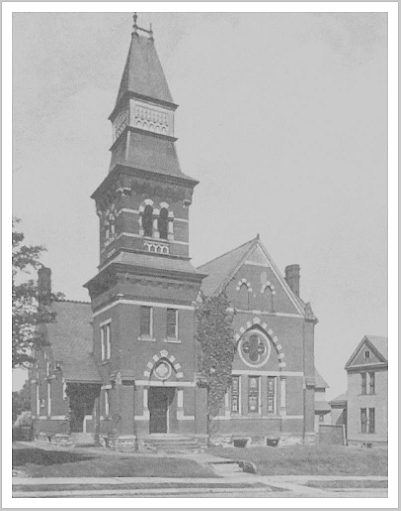
Undated Photo
Bibliography & Resources
- Bombeck, Eric, "Small Town Memories: General James Pierce."
- Dictionary of Unitarian & Universalist Biography: "Cone, Orello."
- Dictionary of Unitarian & Universalist Biography: "Harris, Clarence J."
- Ford, T. M., Record compiled from Sunday to Sunday by T. M. Ford, who until December, 1908, was clerk of the church from its organization. A portion of the record is found in the Twentieth Century History of Mercer County pages 283-285. (see).
- Mehler, Ralph C., Traces of Old Sharpsville. Sharpsville Area Historical Society, Apr 5, 2024
- North Carolina Architects & Builders: "S.W Foulk"
- Pennsylvania History Facebook Group (Pierce History)
- Salt Lake Tribune, 04.20.2018 “Barbara Bush’s old-fashioned religion.”
- Sharpsville Area Historical Society: "Rev. Clarence J. Harris" [PDF]
- Sharpsville Area Historical Society: First Universalist Church Registry Application [PDF]
- The Herald, Sharon, PA, 16 Nov 2001 (brief church history, including Historical Society acquisition).
- University of Akron Archives: General Bulletin 1927-28 [PDF]
- University of Akron Archives: History [PDF]
- White. J. G.,Twentieth Century History of Mercer County, Pennsylvania 1909.
- Visit Mercer County Video of Chloe Memorial Chapel & Museum
Photos Courtesy of Sharpsville Area Historical Society. Reworked by Frank A. Mills
[Church history may be updated as new information comes to light.]